
The Four Stages of Chiropractic Success with Dr Daniel Knowles DC – Chiro Hustle Podcast 797
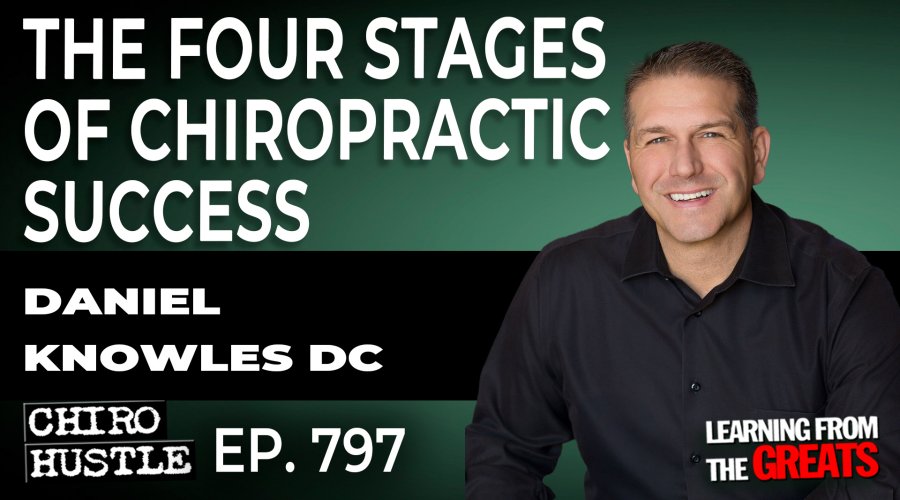
INTRODUCING Dr Daniel Knowles DC
5 Alternate Titles
- Stop Chasing Side Hustles with Dr Daniel Knowles DC – Chiro Hustle Podcast 797
- From Survival to Legacy with Dr Daniel Knowles DC – Chiro Hustle Podcast 797
- Purpose Before Profit with Dr Daniel Knowles DC – Chiro Hustle Podcast 797
- Build the Practice Before the Side Hustle with Dr Daniel Knowles DC – Chiro Hustle Podcast 797
- The Four Stages of Chiropractic Success with Dr Daniel Knowles DC – Chiro Hustle Podcast 797
🧠 Background
What happens when a chiropractor begins looking everywhere except chiropractic for success?
In Episode 797 of the Chiro Hustle Podcast, Dr Daniel Knowles DC challenges what he sees as one of the most dangerous distractions facing the profession: chiropractors abandoning their primary mission in pursuit of the next side hustle, revenue stream, product, therapy, or social-media opportunity.
For Knowles, this isn’t simply a business conversation. It is a question of purpose, identity, service, and responsibility to the people who still have never experienced principled chiropractic care.
His conviction comes from experience.
Early in practice, Knowles and his wife were newly married, living in his parents’ basement, looking for an office and moving without tremendous urgency. Then they learned they were expecting their first child.
Suddenly, there was a deadline.
Nine months.
Nine months to find an office, establish a home, build a practice, and create enough momentum to support a growing family. By the week his son was born, they had built enough practice to hire their first team member.
It wasn’t instant success. It was the beginning of a progression.
Knowles describes four stages of chiropractic practice—Survival, Growth, Scaling, and Legacy—and argues that too many chiropractors want the rewards of Legacy without developing the skills, discipline, systems, communication, leadership, and certainty required to move through the stages that come before it.
His message is simple:
Make the main thing the main thing.
Tell more people about chiropractic. Become a better communicator. Become a better chiropractor. Learn business. Build systems. Develop leaders. Serve more people.
Then build your legacy from abundance—not distraction.
🔥 Highlights
- Why Dr Knowles believes the growing “side hustle” mentality can weaken chiropractic
- The difference between creating another revenue stream from abundance and chasing one from desperation
- Why failure to grow a chiropractic practice is often a skills problem—not a chiropractic problem
- The four stages of practice: Survival, Growth, Scaling, and Legacy
- Why chiropractors cannot skip directly from Survival to Legacy
- How having a baby on the way gave Knowles nine months to turn chiropractic into a real business
- Why chiropractors must learn communication, leadership, delegation, HR, systems, and business
- The simplest answer for chiropractors who need more patients: tell more people about chiropractic
- Why old-school outreach still works when it is backed by conviction
- Model spines, business cards, community talks, office classes, networking, and social media as tools for teaching chiropractic
- Why Knowles believes chiropractic should be communicated as a process rather than an isolated event
- The importance of examining, evaluating, making recommendations, and monitoring progress with certainty
- Why purpose matters more than merely finding something capable of producing income
- The story of Knowles’ son leaving a successful business career and choosing chiropractic because he wanted purpose in his work
- What three generations of chiropractic have taught the Knowles family about living a purpose-filled life
- Why building associates should mean developing future chiropractors—not merely hiring inexpensive labor
- How leadership changes when a practice moves from serving patients to developing people who can serve even more patients
- The role of Mile High in Knowles’ Legacy stage
- Why chiropractic needs chiropractors committed to chiropractic
From Our Sponsors and Partners
JAMES CHESTER (HOST): You made it to Chiro Hustle! Sit back and learn from the greatest influencers in the profession on the world’s number-one chiropractic podcast. Before we dive into this powerful episode, please remember to subscribe to our channels and give us a 5-star rating on iTunes to continue hustling.
This episode is brought to you by…
ChiroHD – More than an EHR; Practice Management, Simplified
The Chiro Speaking Company – Attract, Educate & Convert
ChiroSpring – cloud-based, user-friendly software with all the essential features chiropractors need
The Chiro Hustle Podcast is sponsored by Chiro Health USA, ChiroScript AI, Chiro Moguls, Pure Chiro Notes, Titronics, Sherman College of Chiropractic, Life Chiropractic College West, and the IFCO.
Do you want to support The Sacred Trust and uphold a Subluxation model without the grind of launching a new project? Visit our Patreon, choose the tier best suited for you. That way we can continue keeping “The Big Idea” strong, supporting speech, medical, and family health freedoms.
Now let’s hustle!
📖 Summary
Dr Daniel Knowles DC delivers a direct challenge to chiropractors who are struggling in practice and beginning to believe the answer lies somewhere outside chiropractic.
His argument isn’t against entrepreneurship, investing, writing books, creating businesses, or having multiple streams of income. His concern is sequence.
Don’t use another business to avoid becoming successful at the profession you originally chose.
Knowles describes struggling chiropractors in what he calls the Survival stage. They may be seeing 25, 50, or 100 people a week and comparing themselves to chiropractors seeing hundreds more. Instead of solving the problems immediately in front of them—communication, outreach, recommendations, business systems, staffing, leadership, or clinical certainty—they begin looking for something capable of injecting success into their lives.
A new product.
A new therapy.
An MLM.
A social-media business.
A “side hustle.”
But Knowles argues that the shiny object doesn’t solve the original problem. It divides the chiropractor’s attention while the foundational practice problems remain.
The better question is:
What does the chiropractor need to become in order to move to the next stage?
Knowles describes the progression this way:
Stage 1 — Survival
The chiropractor is primarily responsible for everything. Revenue may be inconsistent. The practice often revolves completely around the doctor. The challenge is developing certainty, communication, outreach, recommendations, and the basic business skills required to create sustainable demand.
Stage 2 — Growth
The practice becomes a genuine organization. Team members are added. Delegation begins. Standard operating procedures become necessary. The chiropractor has to learn HR, communication, coordination, leadership, and how to create an identifiable culture.
Stage 3 — Scaling
The doctor’s job begins changing substantially. Systems, training, infrastructure, culture, associates, and possibly additional locations become increasingly important. The chiropractor spends more time creating an organization capable of serving people than personally performing every function inside it.
Stage 4 — Legacy
The focus expands beyond personal production.
Legacy leaders develop other leaders.
They may build multiple practices, train other chiropractors, invest in other businesses, teach, create organizations, fund projects, write, speak, or use their resources to advance chiropractic.
But Knowles’ central warning is that Legacy cannot simply be imitated. It has to be built.
The lifestyle associated with success is not the same thing as becoming the person capable of creating that success.
And chiropractic still needs chiropractors.
There is no shortage of people who have never been checked, never learned about the spine and nervous system, and never encountered a chiropractor willing to communicate a principled, subluxation-centered message with certainty.
That is why Knowles keeps returning to one remarkably uncomplicated instruction:
Tell more people about chiropractic.
🔍 Diving In
- The Real Danger of the Side Hustle
- The problem isn’t the additional income.
- The problem is what the additional pursuit may reveal.
- Knowles sees many side hustles emerging from a feeling of lack:
- “I’m not successful enough.”
- “I’m not making enough.”
- “My practice isn’t growing.”
- “Maybe this other thing will finally work.”
- When that happens, another business can become an escape from developing the skills required to improve the chiropractic practice itself.
- The chiropractor doesn’t need another identity.
- The chiropractor needs growth.
- That distinction runs through the entire episode.
- Don’t Confuse the Destination With the Next Step
- Knowles uses weight loss as an analogy.
- Someone may look at where they are today and imagine a distant goal. But obsessing over the final number doesn’t remove the need to lose the first five pounds.
- Practice is similar.
- The chiropractor seeing 50 people a week may dream of seeing 500.
- But 500 isn’t the immediate problem.
- Getting from 50 to 75 is.
- Then 75 to 100.
- Then building the infrastructure required for the next stage.
- Success is not one giant leap. It is repeatedly developing the capacity required for the next level.
- Tell More People About Chiropractic
- When asked what a chiropractor seeing only 25 or 50 people per week should do, Knowles doesn’t introduce a complicated funnel.
- His answer:
- Tell more people about chiropractic.
- He remembers his wife carrying a model spine to a stoplight during their early South Carolina practice days and talking to motorists while giving out cards.
- He remembers chiropractor Ari Diskin walking into lunch carrying a spine and business cards.
- His point isn’t that every chiropractor needs to stand beside a traffic light.
- His point is that chiropractors cannot hide.
- Teach classes.
- Carry a spine.
- Talk to people.
- Teach through social media.
- Speak in the community.
- Invite spouses.
- Check children.
- Build relationships.
- Use modern technology—but use it to communicate chiropractic.
- The method may evolve.
- The mission doesn’t.
- Chiropractic Is a Process, Not an Event
- Knowles also challenges chiropractors to examine how they present care.
- A chiropractor shouldn’t simply hope someone likes an adjustment enough to wander back another day.
- Evaluate.
- Find what is happening.
- Explain it.
- Make recommendations.
- Monitor progress.
- Reassess.
- The adjustment may occur at a particular moment, but Knowles argues that chiropractic should be understood as part of a continuing process rather than reduced to an isolated event.
- That requires certainty from the chiropractor.
- And certainty is one of the things Survival-stage chiropractors often lack.
- Purpose Changes Everything
- Perhaps the most personal thread running beneath the business discussion is purpose.
- Knowles’ mother was a chiropractor.
- He became a chiropractor.
- Now his son has chosen chiropractic as well.
- But Knowles doesn’t describe that as simply “passing the torch.”
- His son had already gone to business school and was succeeding professionally. As a teenager he had joked that he wanted to study business first because chiropractors were bad at business.
- Then the business world began to feel empty.
- He was succeeding—but the work lacked purpose.
- Eventually he decided he would rather walk away from that career than continue doing something that didn’t mean enough to him. Chiropractic came back into view not merely as another occupation, but as something capable of giving his work purpose.
- That distinction matters.
- Knowles doesn’t argue that parents should make their children become chiropractors.
- He argues for something larger:
- Teach them to build a purpose-filled life.
- That is the real legacy.
- From Providing Adjustments to Developing Leaders
- As practices grow, the chiropractor’s responsibility changes.
- First you learn to serve.
- Then you learn to lead a team that serves.
- Eventually, you may learn to develop other chiropractors who can serve.
- Knowles is especially clear about associates.
- An associate should not simply be someone brought into an office because the owner is overwhelmed, lonely, or wants inexpensive labor.
- The practice should give that young chiropractor something valuable:
- Better adjusting skills.
- Better communication.
- Better examinations.
- Better business understanding.
- Better leadership.
- Better systems.
- More certainty.
- The associate experience should become a growth environment that accelerates the doctor’s development.
- That is the beginning of Legacy.
- Abundance Before Expansion
- Knowles is not arguing that chiropractors should never own another business, invest in real estate, write books, develop products, or create other income streams.
- He is arguing for doing those things from abundance rather than escape.
- Build something substantial first.
- Serve people.
- Create a profitable practice.
- Develop your team.
- Become a leader.
- Then, when you have something to give, give from the abundance you created.
- That is completely different from reaching for another business because chiropractic never became what you hoped it would become.
⚡ Action Steps
-
- Identify your current stage.
Are you in Survival, Growth, Scaling, or Legacy? Stop judging yourself against someone operating three stages beyond you. - Solve the problems of your current stage.
Don’t use a Legacy-stage strategy to avoid a Survival-stage problem. - Make chiropractic the main thing.
Before adding another business or revenue stream, determine whether your existing practice deserves more of your attention. - Tell more people about chiropractic.
Teach. Speak. Network. Carry the spine. Use social media. Hold classes. Meet your community. - Strengthen your examination and recommendations.
Evaluate people thoroughly, communicate what you find, make clear recommendations, monitor progress, and reassess. - Communicate chiropractic as a process.
Don’t reduce the relationship to a disconnected series of adjustments. - Learn business.
Your DC degree didn’t automatically give you HR, management, delegation, systems, finance, or leadership skills. Develop them. - Build your first team correctly.
Delegation is not simply hiring someone. It requires learning how to communicate expectations, document systems, and lead. - Develop people as you scale.
Create an environment where CAs and associates become better because they worked with you. - Build Legacy from abundance.
When your practice, leadership, and contribution have matured, use that strength to create more leaders and advance chiropractic. - Remember why you entered chiropractic.
There are still people in your community who have never heard the chiropractic story and have never had their spine checked.
Your job isn’t to become distracted by every new opportunity.
Your job is to become exceptionally good at fulfilling your purpose.
YouTube Hashtags
#ChiroHustle #Chiropractic #Subluxation #ChiropracticPhilosophy #DanielKnowles #ChiropracticBusiness #ChiropracticLeadership #PracticeGrowth #ChiropracticSuccess #ChiropracticStudents #NetworkSpinal #MileHigh #Chiropractor #PrincipledChiropractic #ChiropracticLegacy
YouTube SEO Tags
Chiro Hustle, Chiro Hustle Podcast, Chiro Hustle Podcast 797, Daniel Knowles, Dr Daniel Knowles DC, chiropractic podcast, chiropractic philosophy, subluxation chiropractic, subluxation centered chiropractic, principled chiropractic, chiropractic business, chiropractic practice growth, chiropractic success, chiropractic leadership, chiropractic side hustle, side hustles for chiropractors, dangers of side hustles, make the main thing the main thing, chiropractic marketing, grow a chiropractic practice, chiropractic practice management, chiropractic communication, chiropractic patient education, chiropractic associates, chiropractic team building, chiropractic legacy, chiropractic students, chiropractic career, Network Spinal, Mile High chiropractic, Mile High Chiropractic Movement, chiropractic purpose, chiropractic entrepreneur, chiropractic business systems, chiropractic practice stages, chiropractic survival stage, chiropractic scaling, chiropractic community outreach, chiropractic education
- Identify your current stage.
📢 Hashtags:
#ChiroHustle #Chiropractic #Subluxation #ChiropracticPhilosophy #DanielKnowles #ChiropracticBusiness #ChiropracticLeadership #PracticeGrowth #ChiropracticSuccess #ChiropracticStudents #NetworkSpinal #MileHigh #Chiropractor #PrincipledChiropractic #ChiropracticLegacy
Chiro Hustle, Chiro Hustle Podcast, Chiro Hustle Podcast 797, Daniel Knowles, Dr Daniel Knowles DC, chiropractic podcast, chiropractic philosophy, subluxation chiropractic, subluxation centered chiropractic, principled chiropractic, chiropractic business, chiropractic practice growth, chiropractic success, chiropractic leadership, chiropractic side hustle, side hustles for chiropractors, dangers of side hustles, make the main thing the main thing, chiropractic marketing, grow a chiropractic practice, chiropractic practice management, chiropractic communication, chiropractic patient education, chiropractic associates, chiropractic team building, chiropractic legacy, chiropractic students, chiropractic career, Network Spinal, Mile High chiropractic, Mile High Chiropractic Movement, chiropractic purpose, chiropractic entrepreneur, chiropractic business systems, chiropractic practice stages, chiropractic survival stage, chiropractic scaling, chiropractic community outreach, chiropractic education