
Stepping Out of the Grave with Dr Matt Delgado DC – Chiro Hustle Podcast 812
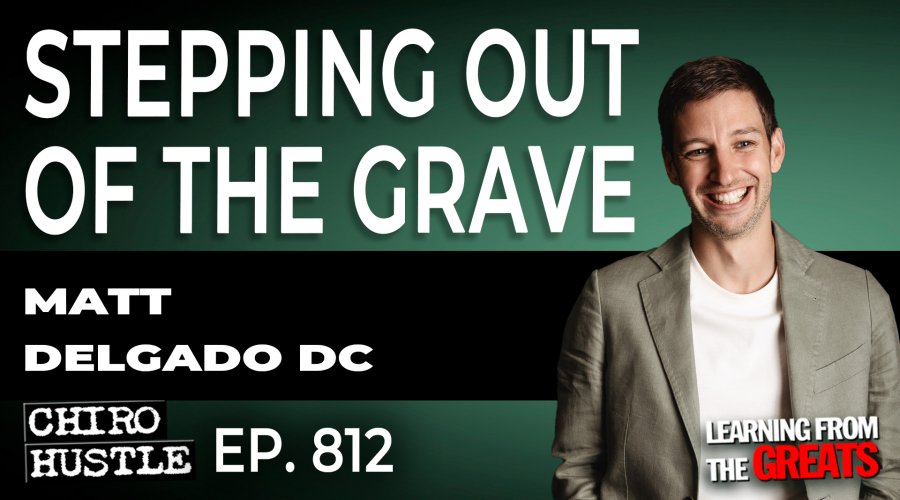
INTRODUCING Dr Matt Delgado DC
5 Alternate Titles
- Treat the Body Like a Plant Not a Car with Dr Matt Delgado DC – Chiro Hustle Podcast 812
- The Body Was Designed to Heal with Dr Matt Delgado DC – Chiro Hustle Podcast 812
- Finding the Roots of Health with Dr Matt Delgado DC – Chiro Hustle Podcast 812
- Stop Fixing Start Asking Why with Dr Matt Delgado DC – Chiro Hustle Podcast 812
- From Graves Disease to a New View of Health – Dr Matt Delgado DC – Chiro Hustle Podcast 812
🧠 Background
Dr Matt Delgado DC entered chiropractic through an experience familiar to many chiropractors: chiropractic changed the trajectory of his own life before it became his profession.
At 15, after concussions, sports injuries, headaches, brain fog, neck pain, and low-back pain, Matt received his first chiropractic adjustment from his uncle. He entered the experience skeptical, believing chiropractors were primarily for older people with bad backs. Instead, the adjustment and the philosophy surrounding it opened an entirely different way of thinking about the human body. He became fascinated with the idea that the body is intelligent and began studying, shadowing chiropractors, and eventually pursuing chiropractic himself.
But the defining story of this episode came after chiropractic school.
Matt completed an accelerated program at Life West and immediately entered an associateship where he says he was working approximately 75 hours a week. Within months, he burned out. Fatigue, brain fog, lethargy, pain, and other problems followed, eventually leading to a diagnosis of Graves disease.
Faced with conventional treatment options that he did not want to pursue at that time, Matt made a dramatic change. He quit his job, moved to southern New Mexico, and spent roughly a year rebuilding his lifestyle around basic inputs: whole foods, sleep, rest, abstaining from alcohol, and reducing the relentless pace at which he had been living.
Matt says his Graves disease subsequently went into remission.
It took him nearly a decade, however, to develop the framework he now uses to describe what that experience taught him: the human body is more like a plant than a car.
A car is repaired by replacing defective pieces. A struggling plant demands a different question: What conditions are preventing it from expressing life?
That distinction transformed Matt’s thinking about chiropractic. Instead of obsessing over individual “branches,” he became increasingly interested in the roots—the central nervous system, adaptation, subluxation, and the lifestyle inputs affecting the person as a whole.
Today, Matt challenges chiropractors to ask “why” more often, reconnect patients with what is natural, and remember that chiropractic is not about convincing people they are broken. It is about addressing interference, supporting function, and respecting the intelligence already present within the human system.
🔥 Highlights
- Matt describes how concussions, headaches, brain fog, and sports injuries led him to his first chiropractic adjustment at age 15.
- He explains why a chiropractor encouraged him to choose a philosophically grounded chiropractic education rather than selecting a school primarily for sports chiropractic.
- Matt recounts completing an accelerated chiropractic program, entering a demanding associateship, and burning out while working approximately 75 hours per week.
- He shares his personal experience of being diagnosed with Graves disease and why that diagnosis forced him to reconsider what health actually requires.
- Matt explains why returning to basics—sleep, whole foods, rest, reducing stressors, and changing his lifestyle—became foundational to his personal health journey.
- The episode introduces Matt’s central metaphor: the body should be approached more like a plant than a car.
- Matt divides the public-facing chiropractic landscape into three broad approaches: pain-focused, structurally focused, and neurologically focused chiropractic.
- He discusses primary, secondary, and tertiary subluxations, adaptation, Torque Release Technique, and the development of his own Tricord Method.
- Matt challenges chiropractors to look upstream at sleep, stress, movement, toxins, nutrition, and nervous-system function instead of becoming consumed by downstream symptoms.
- James Chester and Matt close on a distinctly chiropractic principle: reduce interference, respect the body’s innate intelligence, and allow people to become active participants in their own health.
From Our Sponsors and Partners
JAMES CHESTER (HOST): You made it to Chiro Hustle! Sit back and learn from the greatest influencers in the profession on the world’s number-one chiropractic podcast. Before we dive into this powerful episode, please remember to subscribe to our channels and give us a 5-star rating on iTunes to continue hustling.
This episode is brought to you by…
ChiroHD – More than an EHR; Practice Management, Simplified
The Chiro Speaking Company – Attract, Educate & Convert
ChiroSpring – cloud-based, user-friendly software with all the essential features chiropractors need
The Chiro Hustle Podcast is sponsored by Chiro Health USA, ChiroScript AI, Chiro Moguls, Pure Chiro Notes, Titronics, Sherman College of Chiropractic, Life Chiropractic College West, and the IFCO.
Do you want to support The Sacred Trust and uphold a Subluxation model without the grind of launching a new project? Visit our Patreon, choose the tier best suited for you. That way we can continue keeping “The Big Idea” strong, supporting speech, medical, and family health freedoms.
Now let’s hustle!
📖 Summary
What if the body does not need to be constantly fixed?
Dr Matt Delgado DC joins James Chester for Episode 812 of the Chiro Hustle Podcast to tell the story that fundamentally changed his understanding of health and chiropractic.
Shortly after completing an accelerated chiropractic program, Matt entered an intense associateship and says he was working roughly 75 hours a week. Within months, he burned out and was eventually diagnosed with Graves disease.
That experience began a journey that ultimately led to the central idea behind his forthcoming book, Stepping Out of the Grave: How to Heal When You’re Tired of Trying: the human body is more like a plant than a car.
A mechanic fixes broken parts. But when a plant is struggling, you examine its environment and its roots.
Matt applies that concept to chiropractic by examining pain-focused, structural, and neurologically focused approaches and asking whether chiropractors are spending enough time looking upstream—toward the nervous system, adaptation, lifestyle, and subluxation.
Matt and James explore innate intelligence, patient agency, the chiropractic adjustment, lifestyle, primary subluxation, and why chiropractors should help people understand their bodies rather than convincing them they need someone else to continually “fix” them.
It is a conversation about returning to the roots—both of health and of chiropractic.
🔍 Diving In
There is a deceptively simple question underneath Episode 812:
Do we believe the body is fundamentally a machine that must be fixed, or a living system capable of adaptation, organization, and healing?
Dr Matt Delgado DC argues that the answer changes everything.
His argument is rooted first in personal experience. Matt entered chiropractic after experiencing headaches, brain fog, and pain following sports injuries and concussions. His first chiropractic adjustment at age 15 did more than introduce him to a profession. It introduced him to an idea: the body possesses intelligence.
That philosophical foundation became much more personal after chiropractic school.
Matt describes pushing himself through an accelerated program and then immediately into an associateship requiring roughly 75-hour workweeks. Within three months, he says he hit a wall. He experienced fatigue, brain fog, pain, lethargy, and other problems and was ultimately diagnosed with Graves disease.
Matt’s response was not another attempt to push harder.
He stopped.
He left the job, moved to southern New Mexico, dramatically simplified his life, prioritized sleep and rest, ate whole foods, eliminated alcohol for a year, and began rebuilding from the basics. He says his condition eventually went into remission.
But the intellectual significance of that experience took years to develop.
Matt eventually arrived at the metaphor that organizes this episode and his forthcoming book:
We are more like a plant than a car.
The distinction matters.
When a car malfunctions, the mechanic identifies the defective component, repairs it, replaces it, or compensates for it. Much of modern health culture can easily adopt similar language: find the malfunctioning part and fix it.
A living organism is different.
When a plant begins wilting, we instinctively ask about the conditions in which it is attempting to live. Does it have water? Sunlight? Healthy soil? Are its roots compromised?
We do not normally begin by straightening individual leaves.
Matt believes chiropractors should wrestle seriously with the same distinction.
He describes three broad chiropractic orientations through the eyes of the public: pain-focused, structurally focused, and neurologically focused.
Pain-focused chiropractic concentrates primarily on the symptomatic branch. That can provide tremendous value because pain can dominate a person’s attention and quality of life.
Structural chiropractic examines the tree more broadly. Posture, alignment, X-rays, and structural relationships become measurable indicators through which the chiropractor attempts to improve function.
Matt says much of his own career operated within that structural framework.
The third category—and the direction in which his thinking has evolved—is neurologically focused chiropractic. In his plant analogy, this means paying increasing attention to the “roots”: the central nervous system and the body’s ability to perceive, coordinate, and adapt.
That transition also changed how Matt thought about subluxation.
Through Torque Release Technique and subsequent development of his Tricord Method, he began thinking more deeply about primary subluxation and secondary or tertiary compensations. Rather than treating every observable dysfunction as an isolated problem, he began asking what the body might be doing intelligently in response to stress.
That is where philosophy becomes clinically meaningful.
If the body possesses innate intelligence, adaptation cannot automatically be treated as stupidity.
The chiropractor must ask better questions.
Matt takes that same reasoning beyond the adjustment. Chiropractors have historically discussed the three T’s—thoughts, traumas, and toxins. Yet he argues that the profession sometimes acknowledges those ideas philosophically without adequately helping people understand their everyday implications.
His modernized framework emphasizes sleep, stress, foundational movement, and minimizing toxins, including attention to nutrition and blood-sugar stability.
That does not cause Matt to minimize chiropractic. Near the end of the conversation, he describes the adjustment as an accelerator for restoring function.
The distinction is important.
The chiropractor is not the healer.
The adjustment is not presented as something that substitutes for the body’s intelligence.
Instead, chiropractic addresses interference while the individual takes responsibility for the conditions surrounding the expression of health.
That leads to perhaps the most important professional challenge in the episode: Are chiropractors creating greater agency or greater dependency?
Matt argues that practitioners can unintentionally communicate a story in which patients believe somebody else must continually fix them. His alternative is education: help people understand their bodies, understand natural inputs, understand nervous-system function, and make better decisions themselves.
James summarizes the chiropractic side of that idea at the end of the episode: the objective is not to add something artificial to the body’s intelligence but to address interference so the body has the opportunity to function as designed.
That is why Matt’s Graves disease story is more than an opening anecdote.
It becomes the organizing principle of the entire conversation.
He went looking for another protocol and ultimately concluded that he needed to reconsider the environment in which his body was attempting to function.
He stopped treating himself like a broken car.
He began thinking like a living organism.
And now he is challenging chiropractors to ask whether their philosophy, communication, adjusting, and patient education actually reflect the same principle.
⚡ Action Steps
- Ask why one more time. When encountering dysfunction, resist stopping at the first observable symptom or structural finding.
- Revisit the principle of innate intelligence. Consider what it means clinically if the body is actively adapting rather than merely malfunctioning.
- Examine your subluxation model. Ask whether you distinguish between primary dysfunction and secondary or tertiary compensation.
- Evaluate your patient language. Remove communication that unnecessarily teaches people that they are fragile, broken, or dependent upon someone else to fix them.
- Teach the adjustment clearly. Explain chiropractic in terms of nervous-system function, interference, adaptation, and the objective of the adjustment rather than reducing chiropractic to symptom management.
- Look upstream. Discuss foundational factors such as sleep, stress, movement, nutrition, and environmental inputs when appropriate to your scope and patient needs.
- Use the plant-versus-car test. When developing recommendations, ask whether you are merely repairing a “branch” or considering the conditions affecting the entire living system.
- Preserve the art of chiropractic. Respect different chiropractic techniques while remaining clear about the philosophy and objective guiding your own analysis and adjustment.
- Build patient agency. Give people understandable information that helps them make informed decisions rather than making the practitioner the permanent center of their health.
- Reconnect with chiropractic’s North Star. Study philosophy, gather with other chiropractors, discuss subluxation, get adjusted, and continue asking what makes chiropractic distinct.
📢 Hashtags:
#ChiroHustle #ChiroHustlePodcast #Chiropractic #Chiropractor #Subluxation #ChiropracticPhilosophy #InnateIntelligence #NeurologicalChiropractic #ChiropracticAdjustment #ChiropracticLifestyle #NaturalHealth #NervousSystem #ChiropracticCare #ChiropracticLeadership #PracticeGrowth #PatientEducation #HealthFreedom #MattDelgado #JamesChester
Chiro Hustle Podcast, Chiro Hustle Podcast 812, Dr Matt Delgado DC, Matt Delgado chiropractor, James Chester, chiropractic, chiropractor, chiropractic podcast, subluxation, vertebral subluxation, subluxation based chiropractic, chiropractic philosophy, innate intelligence, universal intelligence, nervous system, central nervous system, neurological chiropractic, neurologically focused chiropractic, chiropractic adjustment, Torque Release Technique, Tricord Method, primary subluxation, secondary subluxation, tertiary subluxation, chiropractic lifestyle, Graves disease story, Stepping Out of the Grave, body designed to heal, plant not a car, chiropractic health, chiropractic students, chiropractic leadership, natural health, patient agency, chiropractic education, Life West chiropractic, Sherman chiropractic, chiropractic profession, chiropractic technique, chiropractic philosophy podcast