
Reverse Engineering Scoliosis with Dr Justin Dick DC – Chiro Hustle Podcast 809
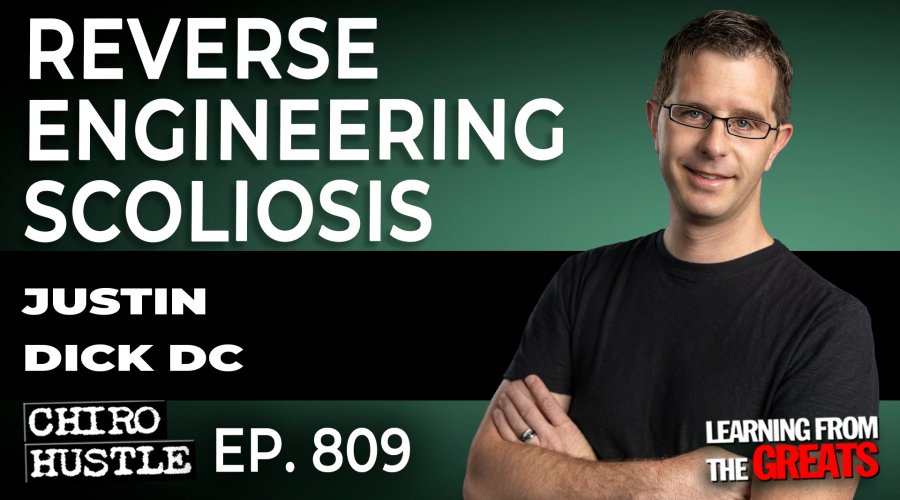
INTRODUCING Dr Justin Dick DC
5 Alternate Titles
- Standing in the Gap with Dr Justin Dick DC – Chiro Hustle Podcast 809
- Structure Determines Function with Dr Justin Dick DC – Chiro Hustle Podcast 809
- The Scoliosis Nobody Sees with Dr Justin Dick DC – Chiro Hustle Podcast 809
- From Disaster Relief to Scoliosis with Dr Justin Dick DC – Chiro Hustle Podcast 809
- Challenging the Impossible with Dr Justin Dick DC – Chiro Hustle Podcast 809
🧠 Background
Before Dr Justin Dick DC ever became a chiropractor, service was already defining his life.
With training in nuclear medicine, computed tomography, and healthcare management, Justin worked inside the hospital system. He saw sophisticated diagnostic technology at work every day, but he also began asking deeper questions about health, healing, and what happened to people after the examination was over.
Then his life took a dramatic turn.
Justin left hospital work and entered full-time disaster ministry. He traveled to places including Japan and Haiti and responded to communities devastated by disasters. When people had lost their homes and possessions, he would arrive and help them begin putting their lives back together. He slept on church floors and in military tents for months at a time because, as he explains in this episode, service is simply who he is.
Chiropractic eventually gave that calling another direction.
Justin had experienced seizures for nearly 30 years. After beginning chiropractic care, he reports that his seizures stopped and he was able to discontinue medication under his circumstances. He is careful not to claim chiropractic “cured” his seizures; instead, he describes the experience through his understanding of the body’s ability to adapt and heal.
His wife had her own story. She had two approximately 45-degree scoliosis curves and sought care from a CLEAR Institute doctor. Justin reports significant structural changes during an intensive period of care, an experience that helped redirect his professional life toward chiropractic and scoliosis.
He attended Sherman College of Chiropractic, embraced subluxation-centered chiropractic, and pursued advanced training through the CLEAR Scoliosis Institute.
Today, difficult scoliosis cases are not something Justin avoids. They are exactly where he wants to serve.
The man who once stood in the gap after disasters now stands in the gap for patients and families facing complex spinal problems.
That connection makes his story powerful:
The setting changed. The mission did not.
🔥 Highlights
- Dr Justin Dick DC explains how nearly 30 years of personal experience with seizures influenced his journey into chiropractic.
- His wife’s scoliosis experience became another major catalyst directing him toward scoliosis-focused practice.
- Justin explains scoliosis as more than a lateral curve, emphasizing rotation, biomechanics, and the importance of evaluating the spine in multiple planes.
- He discusses why sagittal spinal structure—particularly cervical mechanics—is central to the way he evaluates scoliosis.
- Justin makes the case for appropriate radiographic evaluation as an objective tool for identifying, measuring, and monitoring structural change.
- He describes the rigorous education, examination, case review, and continuing expectations involved in CLEAR Institute certification.
- The conversation explores early detection and why identifying abnormal spinal mechanics during childhood may provide opportunities to intervene before larger curves develop.
- Justin discusses working alongside chiropractors and other healthcare professionals in difficult scoliosis cases rather than viewing specialized scoliosis care as an isolated system.
- He challenges chiropractic students and doctors to pursue research, publication, mentorship, and measurable results.
- Justin reveals the deeper story behind his career: years spent in disaster ministry helping people rebuild after losing everything—and how that servant mentality continues through chiropractic.
From Our Sponsors and Partners
JAMES CHESTER (HOST): You made it to Chiro Hustle! Sit back and learn from the greatest influencers in the profession on the world’s number-one chiropractic podcast. Before we dive into this powerful episode, please remember to subscribe to our channels and give us a 5-star rating on iTunes to continue hustling.
This episode is brought to you by…
ChiroHD – More than an EHR; Practice Management, Simplified
The Chiro Speaking Company – Attract, Educate & Convert
ChiroSpring – cloud-based, user-friendly software with all the essential features chiropractors need
The Chiro Hustle Podcast is sponsored by Chiro Health USA, ChiroScript AI, Chiro Moguls, Pure Chiro Notes, Titronics, Sherman College of Chiropractic, Life Chiropractic College West, and the IFCO.
Do you want to support The Sacred Trust and uphold a Subluxation model without the grind of launching a new project? Visit our Patreon, choose the tier best suited for you. That way we can continue keeping “The Big Idea” strong, supporting speech, medical, and family health freedoms.
Now let’s hustle!
📖 Summary
What connects disaster relief, subluxation-centered chiropractic, advanced spinal imaging, scoliosis research, and some of the most challenging cases entering a chiropractic office?
For Dr Justin Dick DC, the answer is service.
In Episode 809 of the Chiro Hustle Podcast, Justin shares the remarkable path that took him from nuclear medicine and hospital-based imaging to international disaster ministry and ultimately into chiropractic.
His own chiropractic testimony and his wife’s experience with scoliosis helped redirect his life toward Sherman College of Chiropractic and advanced scoliosis training through the CLEAR Scoliosis Institute.
Justin and James Chester dive into what scoliosis actually is, why structure and biomechanics matter, the role of X-ray analysis, early detection, cervical and sagittal mechanics, difficult scoliosis cases, interdisciplinary co-management, and the importance of producing research that can withstand scrutiny.
But underneath the technical conversation is a bigger story.
Justin spent years going where people had lost everything and helping them rebuild. Today, he brings that same mentality to people facing complicated spinal problems.
The location changed.
The mission stayed the same:
Stand in the gap. Serve people. Do the difficult work.
🔍 Diving In
Standing in the Gap
- Near the end of Episode 809, Dr Justin Dick DC reveals the story that reframes almost everything heard before it.
- Before chiropractic, Justin worked in nuclear medicine and radiology. But after a mission trip to Kenya, his direction began changing. Eventually, he left hospital work and entered full-time disaster ministry.
- When tornadoes or other disasters destroyed homes and disrupted lives, Justin’s job was to arrive and help people begin rebuilding.
- He lived in Japan. He spent substantial time doing disaster work in Haiti. He slept on church floors and in military tents.
- His explanation is remarkably simple:
- “I’m a servant.”
- He describes his role as standing in the gap when people had lost everything.
- That statement may be the key to understanding his chiropractic career.
When Chiropractic Became Personal
- Justin’s path into chiropractic wasn’t simply an academic decision.
- He reports experiencing seizures for almost 30 years. The condition affected fundamental parts of life, including employment and driving.
- After beginning chiropractic care, Justin says that approximately three months later he was no longer experiencing seizures and was no longer taking the medications he previously used. Importantly, he does not frame this as a claim that chiropractic cured seizures. Instead, he describes the experience through his understanding of adaptation, healing, and the relationship between structure and function.
- Then came his wife’s experience.
- She had significant scoliosis, including two approximately 45-degree curves. After seeking specialized chiropractic scoliosis care, Justin reports measurable changes in her spinal curves along with broader changes in her health experience.
- For Justin, chiropractic had stopped being theoretical.
- It had become personal.
Subluxation at the Foundation
- Justin credits his education at Sherman College of Chiropractic with giving him a subluxation-centered foundation.
- That philosophical grounding remains central to his work.
- Throughout the conversation, he repeatedly returns to structure, function, neurological adaptation, spinal mechanics, and the chiropractic adjustment.
- Even as the discussion moves into sophisticated radiographic analysis, traction, reflexes, biomechanics, and scoliosis rehabilitation, Justin makes his position clear:
- The adjustment remains the foundation of what he does.
- That distinction matters.
- Technology and protocols are tools. The objective is not simply to chase a Cobb angle or produce a better-looking image. His stated approach is to understand how spinal structure and mechanics relate to the whole person and then use objective findings to guide care.
Scoliosis Is More Than a Sideways Curve
- One of the most useful parts of the episode is Justin’s explanation of scoliosis.
- The common description is a lateral curvature visible when viewing the spine from the front or back.
- Justin argues that this is incomplete.
- Rotation is also involved, and he emphasizes the importance of understanding the spine three-dimensionally.
- That means looking beyond the coronal view and studying sagittal mechanics as well.
- Justin discusses his research and clinical observations concerning cervical curves, hypermobility, instability, and scoliosis. He argues that understanding these relationships may provide important clues about the mechanics involved in scoliosis.
- His message to chiropractors is straightforward:
- Don’t simply look at where the curve ended up.
- Ask what mechanics allowed it to develop.
Why X-Rays Matter
- That leads directly into one of the strongest professional discussions in the episode: imaging.
- If a chiropractor claims structural change has occurred, how is that change objectively demonstrated?
- Justin describes radiographic analysis as fundamental to his scoliosis work.
- He discusses using multiple analytical systems and emphasizes repeatable measurements, biomechanics, and defensible documentation.
- This becomes particularly important within CLEAR Institute protocols, where doctors are expected to demonstrate results rather than simply claim them.
- The larger principle extends beyond scoliosis:
- Measure what you intend to change.
Reverse Engineering Difficult Cases
- Justin describes seeing patients with substantial scoliosis curves, including people who may already be approaching or meeting thresholds where surgical consultation becomes part of the conventional conversation.
- Rather than viewing a difficult curve as one isolated problem, he asks where the abnormal mechanics began and how the system is adapting.
- He describes this as a form of reverse engineering.
- If the spine developed into its current configuration through particular biomechanical forces and adaptations, can clinicians identify those forces and strategically influence them?
- His approach combines chiropractic adjustments with other scoliosis-specific interventions intended to influence mechanics and adaptation.
- The larger lesson is not that every curve will respond identically. Justin repeatedly acknowledges that scoliosis presentations vary considerably.
- The lesson is to investigate rather than assume.
Find It Earlier
- Perhaps the most consequential clinical theme is early detection.
- Justin contrasts relatively small curves with the severe curves that eventually arrive in his office.
- Growth matters.
- A young person entering a significant growth period with an existing scoliosis curve may face a very different progression risk than a skeletally mature adult.
- Justin is collecting data examining spinal rotation and sagittal cervical structure in younger children, asking whether biomechanical indicators can be identified before scoliosis is commonly diagnosed.
- That remains a research question—not a finished conclusion—but it represents exactly the kind of question he believes chiropractors should investigate.
- Instead of asking only how to manage advanced scoliosis, ask:
- How early can we recognize abnormal mechanics?
Research Changes the Conversation
- Justin believes chiropractic needs more than passionate practitioners.
- It needs chiropractors willing to publish.
- Research is demanding. He knows that personally.
- His advice to students and younger doctors is to involve academics, document cases, learn the research process, publish in chiropractic journals, and pursue broader indexing such as PubMed when appropriate.
- His point is not to replace chiropractic philosophy with research.
- It is to make chiropractors capable of articulating and investigating what they observe.
- Belief may motivate the doctor.
- Evidence allows the profession to enter a larger conversation.
Learn From People Doing the Work
- Justin closes with straightforward advice for chiropractic students.
- There are many techniques.
- Go find doctors who are producing strong work.
- Watch them.
- Learn from them.
- Ask questions.
- Get exposure to spinal correction and spinal injury concepts even if you ultimately choose another clinical direction.
- Then take what you learn seriously enough to become competent yourself.
- Mentorship helped shape Justin’s career. Now he keeps his own door open for students and doctors who want to learn.
- The cycle becomes:
- Learn. Practice. Measure. Research. Publish. Teach.
The Mission Never Changed
- Justin Dick’s career may appear to contain several disconnected lives.
- Nuclear medicine.
- Radiology.
- Mission work.
- Disaster relief.
- Chiropractic.
- Scoliosis.
- Research.
- But Episode 809 reveals the common thread.
- When people were standing among the remains of homes destroyed by disaster, Justin wanted to be there.
- When families arrive with difficult scoliosis cases and uncertainty about what comes next, he wants to be there too.
- The tools changed.
- The mission didn’t.
Stand in the gap.
⚡ Action Steps
-
-
- Know the chiropractic foundation. Understand subluxation, structure, function, and why the adjustment is central to chiropractic.
- Look beyond symptoms. Pain alone does not describe spinal mechanics or the severity of a scoliosis presentation.
- Understand scoliosis three-dimensionally. Study lateral curvature, rotation, sagittal alignment, and overall biomechanics.
- Measure what you claim to change. When clinically warranted, use appropriate objective assessment and imaging rather than relying on assumptions.
- Learn progression risk. Chiropractors working with children should understand how skeletal maturity and growth can affect scoliosis progression.
- Detect problems earlier. Develop examination procedures that help identify children who warrant further evaluation.
- Know when to refer or co-manage. Complex cases do not have to become professional turf wars. Find qualified clinicians and build relationships.
- Find serious mentors. Study doctors who can demonstrate competence, consistency, and measurable results.
- Document and publish. Turn meaningful clinical observations into research questions and involve qualified academic collaborators.
- Stand in the gap. When a difficult patient, family, student, or colleague needs someone willing to serve, become that person.
-
📢 Hashtags:
#ChiroHustle #ChiroHustlePodcast #Chiropractic #Chiropractor #Subluxation #SubluxationBasedChiropractic #Scoliosis #ScoliosisAwareness #CLEARInstitute #ChiropracticResearch #ChiropracticPhilosophy #ChiropracticAdjustment #SpinalHealth #SpinalBiomechanics #ShermanCollege #ChiropracticStudents #ChiropracticLeadership #ChiropracticEducation #EarlyDetection #StructureDeterminesFunction
Chiro Hustle, Chiro Hustle Podcast, Chiro Hustle Podcast 809, Dr Justin Dick DC, Justin Dick chiropractor, Justin Dick scoliosis, scoliosis chiropractor, chiropractic scoliosis, CLEAR Scoliosis Institute, CLEAR Institute, CLEAR certified chiropractor, scoliosis treatment chiropractic, scoliosis correction, scoliosis early detection, scoliosis research, scoliosis biomechanics, chiropractic research, chiropractic adjustment, subluxation, vertebral subluxation, subluxation based chiropractic, chiropractic philosophy, Sherman College of Chiropractic, structure determines function, spinal biomechanics, cervical curve, sagittal curve, scoliosis X ray, chiropractic X ray, pediatric scoliosis, adolescent scoliosis, chiropractic students, chiropractic mentorship, chiropractic leadership, chiropractic podcast, scoliosis podcast, chiropractic success, chiropractic education