
From a $4 Sandwich to 24 Clinics with Dr Corey Malnikof DC – Chiro Hustle Podcast 798
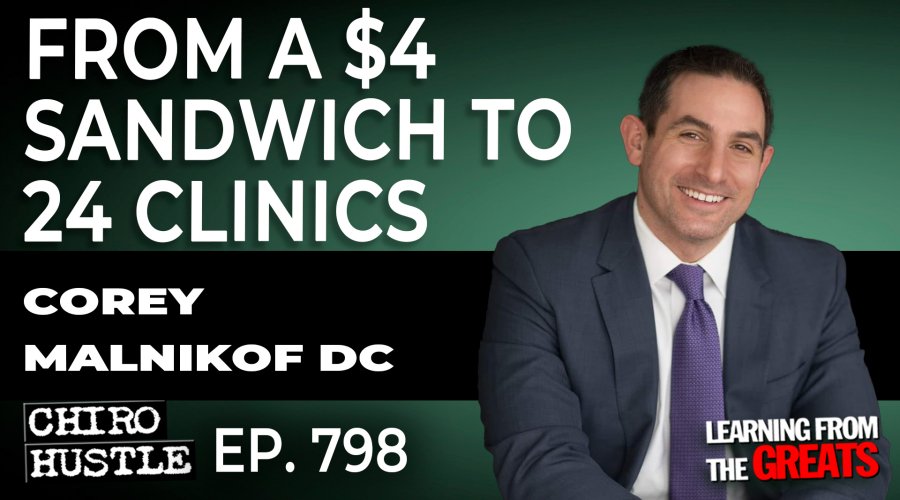
INTRODUCING Dr Corey Malnikof DC
5 Alternate Titles
- They Built Me: From Failure to 24 Clinics with Dr Corey Malnikof DC – Chiro Hustle Podcast 798
- Built by Mentors, Driven by Purpose with Dr Corey Malnikof DC – Chiro Hustle Podcast 798
- Discipline, Philosophy & 24 Clinics with Dr Corey Malnikof DC – Chiro Hustle Podcast 798
- From Broke to Building 24 Clinics with Dr Corey Malnikof DC – Chiro Hustle Podcast 798
- Build the Doctor Before the Practice with Dr Corey Malnikof DC – Chiro Hustle Podcast 798
🧠 Background
Dr Corey Malnikof DC did not set out to build a 24-clinic Chiropractic organization.
He wanted to become a Chiropractor, open a practice, serve people, and change lives.
Then reality hit.
Corey graduated from Palmer College of Chiropractic with tremendous confidence, opened his first practice—and discovered that passion alone does not automatically put people in the office. The patients did not magically appear. The bills did. Eventually, he reached the point behind the story that inspired the title of his book, The $4 Sandwich: he essentially ran out of money.
That could have been the end of the story.
Instead, Corey began studying successful people and successful organizations. He knocked on doors. He called people. He performed screenings. He gave workshops. He learned marketing, leadership, personal development, systems, culture, and business.
Most importantly, he kept going.
One practice became two. Two became four. Eventually, what began as one Chiropractor trying to survive grew into an organization of 24 clinics and roughly 150 team members across multiple states.
But Corey is quick to reject the idea that he built it alone.
His message is: “They built me.”
Guy Riekeman helped ignite his understanding of Chiropractic. Mentors including Fred Barge, Janice Hughes, Larry Markson and others challenged his thinking, pushed him beyond his comfort zone, taught him goal-setting, affirmations, visualization, leadership, and helped him become the person capable of carrying the next level of responsibility.
That is the deeper story of Episode 798.
Not simply how to build more Chiropractic offices—but how to build the Chiropractor who can lead them while maintaining purpose, philosophy, family, culture, and the reason Chiropractic mattered in the first place.
🔥 Highlights
- Corey’s first experience with Chiropractic as a four-year-old boy struggling with asthma.
- How hearing Chiropractic explained through the nervous system and philosophy changed the direction of his life.
- Why Chiropractic’s roots, philosophy, and understanding of subluxation still matter.
- The danger of graduating Chiropractic school believing clinical passion alone will build a practice.
- Corey’s painful early failure and the story behind The $4 Sandwich.
- His first rule for a struggling Chiropractor: “If you don’t have a patient, go get a patient.”
- Knocking doors, calling prospects, screenings, workshops, and doing the uncomfortable work required to build momentum.
- Why discipline and consistency are two of the foundational characteristics of successful people.
- How one struggling practice eventually became 24 clinics.
- Why Corey deliberately walked away from patients and revenue that conflicted with his principles.
- The difference between creating employees and creating people with purpose.
- Why Palmer Care invests heavily in personal development, goals, affirmations, and visualization.
- Corey’s approach to burnout: reconnect with why you became a Chiropractor.
- Creating a culture where the front desk, staff, and doctors understand that their real job is helping people.
- Giving patients a vision beyond symptom relief toward lifelong health and wellness.
- The importance of getting Chiropractic’s message into the community before another healthcare paradigm defines health for the patient.
- Why the profession must teach philosophy rather than merely criticize Chiropractors who have never learned it.
- The mentors Corey credits with “building” him.
- Why growth repeatedly demands becoming a different version of yourself.
- Corey’s return to speaking, podcasts, teaching, and giving back to the profession after years focused primarily on building his organization.
From Our Sponsors and Partners
JAMES CHESTER (HOST): You made it to Chiro Hustle! Sit back and learn from the greatest influencers in the profession on the world’s number-one chiropractic podcast. Before we dive into this powerful episode, please remember to subscribe to our channels and give us a 5-star rating on iTunes to continue hustling.
This episode is brought to you by…
ChiroHD – More than an EHR; Practice Management, Simplified
The Chiro Speaking Company – Attract, Educate & Convert
ChiroSpring – cloud-based, user-friendly software with all the essential features chiropractors need
The Chiro Hustle Podcast is sponsored by Chiro Health USA, ChiroScript AI, Chiro Moguls, Pure Chiro Notes, Titronics, Sherman College of Chiropractic, Life Chiropractic College West, and the IFCO.
Do you want to support The Sacred Trust and uphold a Subluxation model without the grind of launching a new project? Visit our Patreon, choose the tier best suited for you. That way we can continue keeping “The Big Idea” strong, supporting speech, medical, and family health freedoms.
Now let’s hustle!
📖 Summary
What happens when the dream of becoming a successful Chiropractor collides with the reality of an empty office?
You work.
Dr Corey Malnikof DC graduated from Palmer College of Chiropractic fired up about Chiropractic and convinced he was ready to change the world. Then he opened his first office and discovered one of the profession’s hardest lessons:
Knowing Chiropractic and building a Chiropractic practice are two very different skills.
Corey eventually reached the point where money was essentially gone. Instead of abandoning the vision, he started studying.
He studied successful companies. He studied successful people. He studied leadership and personal development. Then he went into his community and worked relentlessly—knocking on doors, calling people, conducting screenings, giving talks and doing whatever ethical work was necessary to introduce more people to Chiropractic.
His simple rule became:
If you don’t have a patient, go get a patient.
That first practice survived.
Then opportunity arrived.
One office became two. Two became four. Over time, Corey found himself leading what would eventually grow into 24 clinics across several states with a team of roughly 150 people.
But the most important part of Corey’s story may be his insistence that the accomplishment cannot be separated from the mentors who built him.
“They built me.”
Guy Riekeman helped give him the philosophical fire for Chiropractic. Janice Hughes taught him to move toward discomfort because growth happens beyond comfortable boundaries. Larry Markson taught him affirmations, visualization, goal-setting and the personal development tools Corey would repeatedly use as the responsibilities became larger.
Other mentors and peer groups expanded his vision of what was possible.
Corey listened.
Then he implemented.
And that may be one of the greatest lessons in this episode: mentorship only becomes valuable when what is learned becomes what is lived.
The conversation also dives deeply into culture and burnout.
Corey argues that people burn out when work becomes nothing more than a repetitive job. At Palmer Care, the goal is to connect every team member to something bigger than their individual task.
The purpose isn’t simply answering phones, checking people in or performing another adjustment.
It is helping create an environment where people can experience greater health and where Chiropractic can express its unique purpose.
For the Chiropractor who feels exhausted, Corey suggests returning to a fundamental question:
Why did I become a Chiropractor?
If that fire remains, reconnect with it.
This is an episode about practice growth, but it is not merely a business conversation.
It is about protecting the philosophical foundation of Chiropractic while becoming capable of carrying a bigger mission.
It is about subluxation, the nervous system, Innate Intelligence, leadership, mentorship, culture, discipline, service and the willingness to keep becoming the person your next responsibility requires.
You may want a bigger practice.
You may want more patients.
You may want more offices.
But first:
Build the Chiropractor capable of carrying the vision.
🔍 Diving In
-
Corey’s early practice did not unfold according to the fantasy many young Chiropractors understandably carry into graduation.
Graduate.
Open the doors.
Put up the sign.
Start adjusting people.
Change the world.
The problem is that the community may not know who you are, what Chiropractic is or why they should walk through your door.
Corey learned that lesson with very little money remaining.
Instead of interpreting the struggle as evidence that Chiropractic did not work, he recognized that his approach to building the practice wasn’t working.
That distinction changed everything.
He began learning, adapting and taking action.
There is an important lesson here for every Chiropractor:
Never confuse difficulty delivering Chiropractic with a failure of Chiropractic itself.
Sometimes the philosophy is sound and the mission is right—but the business skills, communication, leadership or execution still need to grow.
“If You Don’t Have a Patient, Go Get a Patient”
The statement is almost embarrassingly simple.
It is also extraordinarily useful.
When Corey’s schedule was empty, he didn’t remain inside his empty office analyzing why nobody was there.
He went where the people were.
Doors.
Phone calls.
Screenings.
Workshops.
Community conversations.
The technology has changed dramatically in 21 years. Chiropractors now have smartphones, email, Facebook, Instagram, TikTok, video, texting, automated follow-up and countless other ways to communicate.
The principle has not changed.
People cannot choose Chiropractic if nobody introduces them to Chiropractic.
The responsibility to tell the story remains ours.
Principles Before Numbers
One of Corey’s most revealing stories comes from taking over an existing practice.
The office had roughly 80 weekly visits when he arrived.
Then Corey began discovering arrangements and attitudes that conflicted with how he intended to practice and lead. Rather than compromise his standards to protect the existing volume, he was willing to tell people they should not return.
The practice dropped from roughly 80 visits to around 30.
That is leadership.
It is easy to claim principles when principles cost nothing.
Corey was willing to watch his numbers fall.
Then he rebuilt.
That office eventually climbed dramatically beyond where he found it.
The lesson reaches far beyond practice management:
Do not build something you would be ashamed to become responsible for maintaining.
“They Built Me”
Perhaps the most powerful section of the conversation is Corey’s reflection on the people responsible for his development.
Success is often marketed as a story of individual brilliance.
Corey describes something different.
Mentors challenged him.
Teachers gave him tools.
Peers expanded what he believed was possible.
People further down the road reached backward and pulled him forward.
Corey deserves credit for doing something many people never do:
He listened.
Then he acted.
Every major ceiling required another period of personal growth.
Five clinics demanded one version of Corey.
Ten required another.
Twenty required another.
And rather than pretending he automatically possessed what the next chapter required, he asked:
Who do I need to become to handle the next step?
That question may be more valuable than asking, “How do I get bigger?”
Chiropractic Must Be Taught
The philosophical heart of Episode 798 is a concern shared throughout the conversation: Chiropractic cannot assume future generations will automatically understand the principles earlier generations were taught.
Subluxation.
The nervous system.
Innate Intelligence.
The philosophy, science and art of Chiropractic.
The Sacred Trust.
These ideas survive only when Chiropractors intentionally communicate them.
But the episode also introduces an important distinction.
Teaching Chiropractic philosophy does not require attacking Chiropractors who were never properly exposed to it.
If someone does not know, teach.
If students are not hearing the message, bring them the message.
If patients have never understood Chiropractic beyond aches and pains, tell them the story.
Protecting Chiropractic is not accomplished simply by identifying what is wrong.
It requires creating more people who understand what is right.
Culture Is More Than an Employee Handbook
Corey identifies culture as one of Palmer Care’s greatest accomplishments.
That culture begins with meaning.
A team member’s job cannot merely be checking patients in.
A Chiropractor’s job cannot become mechanically moving from room to room.
When work loses purpose, burnout follows.
Corey attempts to keep his people “green and growing” through personal goals, affirmations, visualization, education, training, connection and continual development.
The objective is not merely to build more productive employees.
It is to build stronger human beings.
Stronger people show up differently.
They communicate differently.
They lead differently.
And ultimately, they serve patients differently.
Work-Life Balance Begins With Non-Negotiables
Despite overseeing a large organization, Corey describes one personal rule clearly:
He doesn’t miss his children’s important events.
Practices.
Games.
Activities.
He may bring a computer and continue handling responsibilities, but physically being there is non-negotiable.
There is a useful distinction here.
Balance does not necessarily mean dividing every day equally among every priority.
It means knowing which priorities are not negotiable before circumstances decide for you.
Stop Treating Chiropractic Like an Expensive Band-Aid
A recurring theme throughout the episode is the danger of reducing Chiropractic to short-term symptom management.
Corey describes showing patients a larger vision—from the immediate problem through corrective care and ultimately into wellness.
The objective is not coercion.
It is education.
Show people what is possible.
Explain the vision.
Then let them participate in decisions about their health.
That philosophy gives the doctor and the patient something greater to pursue than simply waiting for pain to disappear.
Chiropractic’s conversation must remain bigger than symptoms.
⚡ Action Steps
-
-
1. Reconnect with your “why.”
Write down why you became a Chiropractor before business pressures, bills, paperwork and daily repetition began competing for your attention.
2. Define Chiropractic clearly.
Can you explain subluxation, the nervous system, Innate Intelligence and the purpose of the adjustment in language a patient can understand?
If not, work on it.
3. Tell the story.
If your schedule has openings, don’t stare at the openings.
Call.
Text.
Speak.
Create content.
Visit businesses.
Meet community leaders.
Hold workshops.
Get where people are.
4. Identify your current ceiling.
Ask:
“Who must I become to carry the next level of responsibility?”
Then identify the knowledge, discipline or leadership ability you currently lack.
5. Find people who have already crossed that ceiling.
Mentorship matters.
Listen to people producing results congruent with the person and Chiropractor you want to become.
6. Implement.
Information without execution changes nothing.
Take one idea and put it into practice immediately.
7. Protect your principles.
Never become dependent on patients, systems, agreements or revenue that require you to violate the standards on which you want your practice built.
8. Build your people.
Help staff and associates grow personally as well as professionally.
A great culture cannot be separated from the growth of the people inside it.
9. Define your family non-negotiables.
Decide in advance what you refuse to sacrifice in the name of success.
10. Teach Chiropractic.
If the next generation does not understand Chiropractic philosophy, don’t merely complain about what they weren’t taught.
Teach them.
-
📢 Hashtags:
#ChiroHustle #Chiropractic #Chiropractor #ChiropracticPhilosophy #Subluxation #VertebralSubluxation #InnateIntelligence #PalmerChiropractic #ChiropracticBusiness #PracticeGrowth #ChiropracticLeadership #ChiropracticMarketing #ChiropracticStudents #ChiropracticSuccess #SacredTrust
Chiro Hustle, Chiro Hustle Podcast, Chiro Hustle Podcast 798, Corey Malnikof, Dr Corey Malnikof, Corey Malnikof DC, chiropractic podcast, chiropractic, chiropractor, chiropractic philosophy, subluxation, vertebral subluxation, innate intelligence, universal intelligence, Palmer College of Chiropractic, Palmer chiropractic, chiropractic business, chiropractic practice growth, chiropractic marketing, chiropractic leadership, chiropractic success, build a chiropractic practice, grow a chiropractic practice, chiropractic mentorship, chiropractor mentor, chiropractic students, new chiropractor, chiropractic career, chiropractic culture, chiropractic team building, chiropractic burnout, chiropractor work life balance, chiropractic personal development, chiropractic goals, chiropractic affirmations, chiropractic visualization, chiropractic screenings, spinal screenings, chiropractic community outreach, chiropractic wellness, nervous system chiropractic, principled chiropractic, subluxation based chiropractic, Sacred Trust, BJ Palmer, Guy Riekeman, chiropractic future, chiropractic profession