
Three Bulging Discs Changed Everything with Dr Dan Ruitenbeek DC – Chiro Hustle Podcast 813
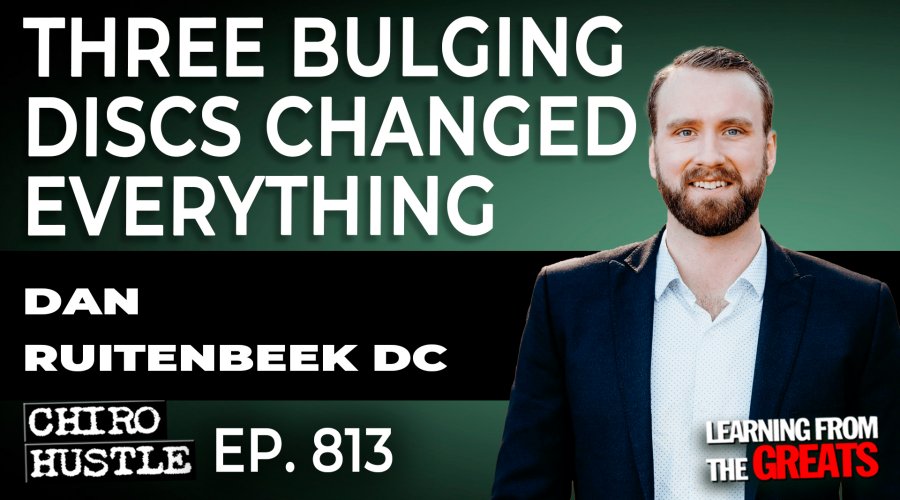
INTRODUCING Dr Dan Ruitenbeek DC
5 Alternate Titles
- Chiropractic Changed His Life at 16 with Dr Dan Ruitenbeek DC – Chiro Hustle Podcast 813
- From Disc Injury to Chiropractic Innovator with Dr Dan Ruitenbeek DC – Chiro Hustle Podcast 813
- Building a Better Future for Chiropractic with Dr Dan Ruitenbeek DC – Chiro Hustle Podcast 813
- The Missing Link in Chiropractic Practice with Dr Dan Ruitenbeek DC – Chiro Hustle Podcast 813
- Helping Chiropractors Do What Only Chiropractors Can Do with Dr Dan Ruitenbeek DC – Chiro Hustle Podcast 813
🧠 Background
Dr. Dan Ruitenbeek DC did not discover chiropractic through a textbook, seminar, or career fair. He discovered it because, at 16 years old, he desperately needed help.
Growing up in London, Ontario, Canada, Dan was immersed in competitive hockey. At 6’5″ and only about 165 pounds during adolescence, his body was absorbing tremendous forces several times a week on the ice. Eventually, he developed three bulging discs in his lower back. His condition progressed to the point that he says he lost the ability to voluntarily contract his left quadriceps.
Surgery was being considered, but his physician encouraged him to explore conservative options first. Physical therapy provided temporary relief, but Dan says his problems continued to return.
Then a friend encouraged him to visit a chiropractor.
Within approximately three weeks, Dan says he was essentially pain-free. Within three months, he was back playing hockey.
That experience redirected his life.
Already interested in kinesiology and biomechanics, Dan began spending time inside his chiropractor’s office, observing patient care and learning what the profession could offer. Chiropractic combined several things he wanted in a career: working with people, using his hands, understanding human function, and building a business of his own.
He eventually attended Life University and graduated in 2018.
But clinical practice would become only part of his chiropractic journey.
Dan and his wife developed a multidisciplinary practice environment that includes chiropractic alongside holistic and functional health approaches. He also created Recover X, an accessible “biohacking for real people” concept incorporating technologies and strategies such as sauna, cold exposure, oxygen-based exercise, sound therapy, red light, and halotherapy.
His earlier experience working as a chiropractic assistant with shockwave technology ultimately became another unexpected pathway. What began as hands-on clinical experience eventually grew into Shockwave Centers of America, a company Dan says now supports nearly 3,000 offices across nine countries.
Today, Dan’s focus extends beyond equipment.
He is increasingly interested in developing the chiropractic assistant into a highly trained, professional, valuable member of the chiropractic healthcare team—allowing chiropractors to remain focused on the responsibility that belongs uniquely to them: being chiropractors.
Episode 813 is ultimately about evolution: the evolution of a patient into a chiropractor, a chiropractor into an entrepreneur, and an entrepreneur into someone working to build stronger systems for the profession.
🔥 Highlights
- Dr. Dan Ruitenbeek’s chiropractic story began with three bulging lumbar discs at only 16 years old.
- His condition became severe enough that he says he lost the ability to voluntarily contract his left quadriceps.
- After temporary results through physical therapy, a friend’s recommendation led him to chiropractic.
- Dan says he was essentially pain-free within three weeks and back playing competitive hockey within three months.
- He explains why chiropractic students must recognize that earning a license is only part of their education.
- Dan encourages students to deliberately seek mentors, clubs, technique training, internships, and real-world practice exposure while still in school.
- His Recover X concept aims to make biohacking accessible to ordinary people rather than treating health optimization as something reserved for expensive or extreme interventions.
- Dan explains how his early experience using shockwave technology as a chiropractic assistant eventually helped lead to Shockwave Centers of America.
- He makes the case for professionally trained chiropractic assistants who can provide meaningful support while allowing the chiropractor to remain focused on chiropractic.
- The episode closes with an important reminder: mentors can identify blind spots that practitioners may never recognize on their own.
From Our Sponsors and Partners
JAMES CHESTER (HOST): You made it to Chiro Hustle! Sit back and learn from the greatest influencers in the profession on the world’s number-one chiropractic podcast. Before we dive into this powerful episode, please remember to subscribe to our channels and give us a 5-star rating on iTunes to continue hustling.
This episode is brought to you by…
ChiroHD – More than an EHR; Practice Management, Simplified
The Chiro Speaking Company – Attract, Educate & Convert
ChiroSpring – cloud-based, user-friendly software with all the essential features chiropractors need
Kordara Health – Kodara Health works with doctors & chiropractors to help them build an “AI Version” of themselves so they can stop seeing patients 1-on-1 in person, and be able to scale their clinic fully online.The Chiro Hustle Podcast is sponsored by Chiro Health USA, ChiroScript AI, Chiro Moguls, Pure Chiro Notes, Titronics, Sherman College of Chiropractic, Life Chiropractic College West, and the IFCO.
Do you want to support The Sacred Trust and uphold a Subluxation model without the grind of launching a new project? Visit our Patreon, choose the tier best suited for you. That way we can continue keeping “The Big Idea” strong, supporting speech, medical, and family health freedoms.
Now let’s hustle!
📖 Summary
Three bulging discs at 16 years old could have permanently changed the direction of Dr. Dan Ruitenbeek’s life.
In a sense, they did.
After struggling with a serious hockey-related low-back injury and even losing voluntary function in his left quadriceps, Dan was introduced to chiropractic. He says he was essentially pain-free within three weeks and returned to hockey within three months.
That experience eventually led him to Life University, chiropractic practice, entrepreneurship, Recover X, and Shockwave Centers of America.
In Episode 813 of the Chiro Hustle Podcast, James Chester and Dr. Dan Ruitenbeek DC discuss far more than technology and business. They explore how chiropractors evolve throughout their careers, why students must intentionally seek education outside the formal curriculum, and why mentorship remains essential long after graduation.
Dan also presents a larger vision for the chiropractic assistant.
Instead of viewing CAs primarily as administrative overhead, he believes the profession can establish stronger education, standards, certification, and meaningful career pathways that allow highly trained assistants to support patient care while freeing chiropractors to concentrate on the work that only chiropractors are trained to perform.
It’s a conversation about chiropractic, innovation, professional development, and building systems capable of serving more people without losing sight of the chiropractor’s central purpose.
🔍 Diving In
When the Patient Becomes the Chiropractor
- Some chiropractors enter the profession because chiropractic sounded interesting.
- Others enter because chiropractic became personal.
- For Dr. Dan Ruitenbeek DC, it became personal at 16.
- Competitive hockey had been a major part of his youth in London, Ontario. But several days a week of high-speed physical competition eventually took its toll. Dan developed three bulging discs in his lower back, and his condition became severe enough that he says he could no longer voluntarily contract his left quadriceps.
- Surgery was potentially waiting at the end of the road.
- Before taking that step, however, his physician encouraged him to explore conservative options.
- Physical therapy helped temporarily, but the benefit did not last.
- Then someone told him to see a chiropractor.
- Three weeks later, Dan says he was essentially pain-free.
- Three months later, he was playing hockey again.
- That did more than change his physical condition.
- It changed the trajectory of his life.
Chiropractic Is More Than What Happens in School
- Dan eventually enrolled at Life University, graduating in 2018.
- One of the strongest messages he offers students in this episode is that chiropractic college has an important—but limited—job.
- The institution must prepare students academically and help them meet the requirements necessary for licensure.
- But becoming the chiropractor they ultimately want to become requires something more.
- Students must intentionally seek it.
- Dan encourages future chiropractors to explore technique clubs, seminars, mentors, internships, business education, and different models of chiropractic practice.
- Those years should not simply be survived.
- They should be used to discover identity.
- What techniques resonate with you?
- What kind of office do you want?
- Whom do you want to serve?
- What philosophy guides your decisions?
- What skills will you actually need when the classroom disappears and the patient is standing in front of you?
- Those questions cannot be answered entirely by a curriculum.
Allow Yourself to Evolve
- Another recurring idea throughout the conversation is professional evolution.
- A chiropractor does not need to remain frozen in the exact practice model imagined at graduation.
- Dan describes how his own patient population changed as his life changed.
- Before having children, he and his wife naturally attracted many young professionals. As they became parents themselves, more pediatric and prenatal patients began entering their world.
- Growth does not necessarily mean abandoning principle.
- It may mean finding better ways to express it.
- Technique can evolve.
- Communication can evolve.
- Business systems can evolve.
- The population you serve can evolve.
- But the chiropractor still needs clarity about what chiropractic uniquely contributes.
Chiropractic as the Foundational Biohack
- Dan’s Recover X project grew from another observation.
- Modern “biohacking” can easily become complicated, expensive, or inaccessible.
- His philosophy is much simpler: make positive biological inputs practical enough that ordinary people can actually use them consistently.
- Recover X incorporates approaches including sauna, cold exposure, exercise with oxygen, sound-based relaxation technologies, red light, and halotherapy.
- Yet the conversation brings the discussion back to chiropractic.
- James describes chiropractic as the original biohack because of its focus on the nervous system and the body’s internal capacity to function and adapt.
- Within the Chiro Hustle framework, the adjustment is not merely another technology sitting beside the others.
- Chiropractic maintains its distinct identity through the detection and correction of vertebral subluxation and respect for the intelligence expressed through the human organism.
- Additional technologies may support people.
- They do not replace the chiropractor.
From Chiropractic Assistant to International Business
- Ironically, one of Dan’s largest professional ventures began before he became a chiropractor.
- While working as a chiropractic assistant in Canada, one of his responsibilities was operating a shockwave device.
- That early exposure gave him practical experience with technology that he says received very little attention during chiropractic school.
- When he later entered practice, other chiropractors began asking him how he was implementing shockwave.
- What cases made sense?
- How should the technology fit into an office?
- How could doctors incorporate it without allowing ancillary services to overpower their chiropractic message?
- Those conversations developed into consulting.
- Consulting developed into a business.
- Dan partnered with David, a patient with a background in medical manufacturing and distribution, and what began as an entrepreneurial experiment ultimately became Shockwave Centers of America.
- Dan says the organization has grown into nearly 3,000 offices across nine countries.
- But the most interesting part of the story may not be the machine.
- It may be the workforce question the machine exposed.
The Chiropractic Assistant May Be an Untapped Profession
- A chiropractor has limited time.
- There are only so many hours available to examine, educate, adjust, document, manage the office, lead employees, communicate with patients, and operate a business.
- The adjustment, however, remains uniquely chiropractic.
- Dan’s question is straightforward:
- What responsibilities could a properly trained chiropractic assistant safely and legally perform so the chiropractor can concentrate on being the chiropractor?
- Some states have already developed more formal CA certification or regulatory pathways.
- Dan believes the profession should examine that model seriously.
- Instead of treating the CA position as an entry-level job with limited advancement, chiropractic could potentially create a genuine professional pathway.
- Education.
- Certification.
- Defined scope.
- Greater responsibility.
- Better compensation.
- Longer careers.
- Higher standards.
- And ultimately, stronger chiropractic practices.
- That could also create another unexpected benefit.
- The chiropractic assistant may become one of the profession’s best recruiting pipelines.
Someone who spends years witnessing chiropractic, caring for patients, understanding office systems, and seeing lives change may eventually decide:
“I want to become the chiropractor.”
Keep the Chiropractor Chiropractic
- This is where the different threads of Episode 813 ultimately converge.
- Technology matters.
- Business matters.
- Collaboration matters.
- Mentorship matters.
- Staff development matters.
- But none of these should cause chiropractors to lose sight of what belongs uniquely to the chiropractor.
- The profession becomes stronger when chiropractors become clearer—not blurrier—about their responsibility.
- Detect subluxation.
- Correct subluxation.
- Communicate chiropractic.
- Develop extraordinary adjusting skills.
- Protect the chiropractor’s time so that the chiropractor can perform the work only a chiropractor is trained to perform.
- Then build intelligent systems around that central responsibility.
Dr. Dan Ruitenbeek’s story began because one chiropractor helped a 16-year-old athlete when he needed another option.
Years later, Dan is working on systems that may help thousands of chiropractors become better equipped to serve the next person walking through the door.
One story became a career.
The career became a mission.
And the mission continues.
⚡ Action Steps
- Clarify why you practice.
Know what chiropractic means to you before adding techniques, technologies, or services around it. - Protect the adjustment.
Identify tasks that consume doctor time but do not actually require the chiropractor. - Invest in your CA.
Treat excellent chiropractic assistants as professionals worth developing rather than interchangeable employees. - Create a career pathway for staff.
Give team members opportunities to increase skill, responsibility, compensation, and leadership. - Find mentors before you desperately need them.
Do not wait until your practice or career is in crisis to ask for help. - Students: use school strategically.
Learn the curriculum, pass the boards, and simultaneously explore techniques, clubs, seminars, internships, and mentorship. - Develop more than one skill set.
Build enough clinical versatility to appropriately serve the diverse people who may enter your practice. - Evaluate every new technology through chiropractic principles.
Ask whether it strengthens the practice or distracts the office from its central purpose. - Allow your practice to evolve.
Your patients, communication, interests, and systems may change throughout your career without requiring you to abandon your principles. - Get out of your own way.
Invite people you trust to identify your blind spots, then have enough humility to work on them.
📢 Hashtags:
#ChiroHustle #Chiropractic #Chiropractor #ChiropracticPhilosophy #Subluxation #VertebralSubluxation #ChiropracticAdjustment #InnateIntelligence #ChiropracticStudents #ChiropracticAssistant #ChiropracticBusiness #ChiropracticLeadership #PracticeGrowth #ChiropracticEntrepreneur #ShockwaveTherapy #Biohacking #NaturalHealth #LifeUniversity #ChiropracticCareer #SacredTrust
Chiro Hustle, Chiro Hustle Podcast, Chiro Hustle Podcast 813, Dr Dan Ruitenbeek DC, Dan Ruitenbeek chiropractor, chiropractic podcast, chiropractic philosophy, chiropractic subluxation, vertebral subluxation, subluxation based chiropractic, chiropractic adjustment, Innate Intelligence, Universal Intelligence, Educated Intelligence, Sacred Trust chiropractic, chiropractic students, chiropractic student advice, Life University chiropractic, chiropractic career advice, chiropractic mentorship, chiropractic coaching, chiropractic business, chiropractic entrepreneurship, chiropractic practice growth, chiropractic leadership, chiropractic assistant, chiropractic assistant training, chiropractic assistant certification, CA chiropractic, Shockwave Centers of America, shockwave chiropractic, shockwave therapy chiropractic, chiropractic technology, Recover X, chiropractic biohacking, biohacking for real people, natural health, conservative healthcare, chiropractic innovation, future of chiropractic, chiropractic practice systems, chiropractic staff training, chiropractic team development, chiropractic profession, James Chester