
From Medical Sales to the Sacred Trust with Dr Nicholas Lim Rui-Xin DC – Chiro Hustle Podcast 816
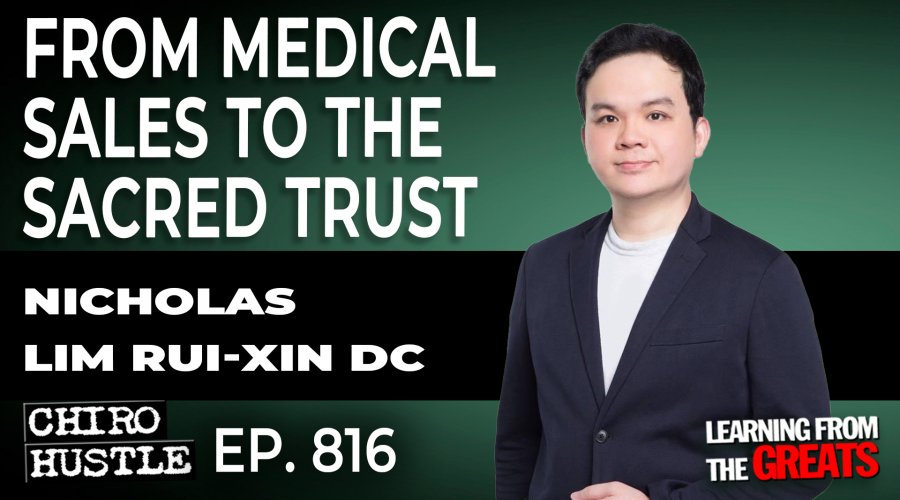
INTRODUCING Dr Nicholas Lim Rui-Xin DC
5 Alternate Titles
1. Protecting the Sacred Trust in Asia with Dr Nicholas Lim Rui-Xin DC – Chiro Hustle Podcast 816
2. Bringing Chiropractic Back to Its Roots with Dr Nicholas Lim Rui-Xin DC – Chiro Hustle Podcast 816
3. Beyond Neck and Back Pain with Dr Nicholas Lim Rui-Xin DC – Chiro Hustle Podcast 816
4. Building Vitalistic Chiropractic in Asia with Dr Nicholas Lim Rui-Xin DC – Chiro Hustle Podcast 816
5. 80 Seminars and One Chiropractic Mission with Dr Nicholas Lim Rui-Xin DC – Chiro Hustle Podcast 816
🧠 Background
Dr Nicholas Lim Rui-Xin DC did not simply choose chiropractic. In many ways, chiropractic kept calling him until he finally answered.
Growing up in Singapore, Nicholas remembers recurring health struggles, including fevers, digestive problems, difficulty sleeping, and other concerns that seemed to improve temporarily but repeatedly returned. His family eventually introduced him to chiropractic. After receiving care himself, Nicholas became fascinated by what he experienced and began considering chiropractic as a career.
But there was a problem: pursuing that calling meant traveling halfway around the world and accepting the substantial financial commitment of attending chiropractic school in the United States.
So he waited.
For roughly ten years, chiropractic remained in the background while Nicholas studied, worked, and eventually became a medical sales representative. Then corporate restructuring changed everything. When approximately half his department was eliminated, Nicholas confronted a hard lesson about building his future around someone else’s organization.
The chiropractic dream he had shelved came back into focus.
Within about a year, he was in Davenport, Iowa, studying at Palmer College of Chiropractic.
Nicholas did much more than complete the curriculum. Knowing he planned to return to Singapore, where access to chiropractic seminars and mentors would be more limited, he immersed himself in the profession. He attended more than 80 seminars, studied adjusting approaches and chiropractic philosophy, developed relationships with mentors across the profession, participated in mission trips, helped establish an MLS Club at Palmer, and eventually gravitated toward Zone Technique and its historical roots in Dr Thurman Fleet’s work.
Today, Nicholas practices in Singapore while helping build a stronger subluxation-centered chiropractic community throughout Asia.
His interests extend beyond technique. He is passionate about chiropractic history and recently presented on the profession’s historical involvement with mental health institutions—material he says many chiropractors and students in Asia had never encountered.
He is also part of the Alliance of Chiropractic Singapore and the movement behind the Asia Chiropractic Summit, created to give chiropractors throughout the region greater access to community, philosophy, education, and mentorship.
Nicholas’s journey is ultimately about more than one chiropractor.
It is about discovering where chiropractic came from, learning everything possible from those carrying it today, and deliberately passing that inheritance forward.
🔥 Highlights
1. Nicholas shares how his own childhood health experiences first introduced him to chiropractic.
2. He explains why the dream of becoming a chiropractor remained unfinished for roughly ten years.
3. A major restructuring during his medical sales career forced him to reconsider what security and independence really meant.
4. Nicholas describes leaving Singapore for Davenport, Iowa, to study at Palmer College of Chiropractic.
5. He explains why he attended more than 80 chiropractic seminars and immersed himself in mentorship while living in the United States.
6. Nicholas discusses Zone Technique, Dr Peter Goldman, Dr Thurman Fleet, Concept Therapy, and the importance of having a system for analyzing and addressing subluxation.
7. He shares why he believes chiropractic must resist being reduced to a neck-and-back-pain profession.
8. Nicholas discusses his research into chiropractic history and the profession’s historical involvement with mental health institutions.
9. He explains why chiropractors in Singapore came together to create a regional seminar and strengthen vitalistic, subluxation-centered chiropractic throughout Asia.
10. Nicholas closes with a global challenge: chiropractors across countries and continents must work together to protect and carry forward chiropractic’s Sacred Trust.
From Our Sponsors and Partners
JAMES CHESTER (HOST): You made it to Chiro Hustle! Sit back and learn from the greatest influencers in the profession on the world’s number-one chiropractic podcast. Before we dive into this powerful episode, please remember to subscribe to our channels and give us a 5-star rating on iTunes to continue hustling.
This episode is brought to you by…
ChiroHD – More than an EHR; Practice Management, Simplified
The Chiro Speaking Company – Attract, Educate & Convert
ChiroSpring – cloud-based, user-friendly software with all the essential features chiropractors need
Kordara Health – Kodara Health works with doctors & chiropractors to help them build an “AI Version” of themselves so they can stop seeing patients 1-on-1 in person, and be able to scale their clinic fully online.The Chiro Hustle Podcast is sponsored by Chiro Health USA, ChiroScript AI, Chiro Moguls, Pure Chiro Notes, Titronics, Sherman College of Chiropractic, Life Chiropractic College West, and the IFCO.
Do you want to support The Sacred Trust and uphold a Subluxation model without the grind of launching a new project? Visit our Patreon, choose the tier best suited for you. That way we can continue keeping “The Big Idea” strong, supporting speech, medical, and family health freedoms.
Now let’s hustle!
📖 Summary
What happens when a dream waits ten years for you to finally act on it?
In Chiro Hustle Podcast 816, James Chester sits down with Dr Nicholas Lim Rui-Xin DC of Singapore for a conversation about calling, chiropractic history, mentorship, technique, philosophy, and the future of subluxation-centered chiropractic in Asia.
Nicholas first encountered chiropractic through his own health journey. Although he considered becoming a chiropractor years earlier, the financial realities of studying overseas caused him to put the idea aside. A decade later, restructuring during his career in medical sales changed his perspective. He decided it was time to build something of his own and pursue the profession that had continued calling him.
That decision eventually took him to Palmer College of Chiropractic in Davenport, Iowa.
Nicholas knew his time in America was an opportunity he could not waste. He attended more than 80 seminars, sought mentors, studied technique and philosophy, participated in mission work, and built relationships throughout chiropractic.
Today, he has brought those lessons home to Singapore.
Nicholas and James discuss Zone Technique, the historical breadth of chiropractic, the danger of reducing the profession to neck and back pain, and the growing effort to preserve vitalistic, subluxation-centered chiropractic throughout Asia.
This is the story of a chiropractor who traveled thousands of miles to discover chiropractic more deeply—then returned home determined to help carry its principles forward.
🔍 Diving In
A DREAM DELAYED—NOT ABANDONED
One of the most powerful parts of Dr Nicholas Lim Rui-Xin DC’s story is that becoming a chiropractor was not a quick or obvious decision.
Chiropractic entered his life personally first.
Nicholas describes growing up with recurring health challenges and going through different approaches while looking for answers. Chiropractic eventually became part of his family’s experience, and after receiving chiropractic care himself, Nicholas began considering whether this profession might become his own life’s work.
But wanting something and acting on it are different things.
For Nicholas, studying chiropractic meant leaving Singapore, moving across the world, and taking on the substantial financial burden of an American chiropractic education. The dream was real, but so were the obstacles.
He put it aside.
Approximately ten years passed.
Then the career he had built in medical sales was disrupted when his company restructured and eliminated a large portion of his department. Nicholas saw firsthand that the apparent security of working for someone else could disappear.
The old question returned:
What happened to chiropractic?
This time, he answered it.
Within roughly a year, Nicholas had gone from discussing the possibility with his family to living in Davenport, Iowa, and attending Palmer College of Chiropractic.
LEARNING BEFORE GOING HOME
Nicholas approached his education with an unusual urgency.
He knew he intended to return to Singapore. He also knew that the seminar opportunities, teachers, chiropractors, and professional network surrounding him in the United States would not necessarily be waiting for him back home.
His conclusion was simple: learn now.
That attitude led Nicholas to more than 80 seminars.
But the number itself is not the important part.
Those seminars exposed him to people.
Mentors.
Different techniques.
Different interpretations of chiropractic.
Different pieces of the profession’s history.
And relationships that led to still more relationships.
Nicholas describes chiropractic education as something much larger than completing a college curriculum. One person introduced him to another. One seminar exposed him to another teacher. Friendships became study relationships. Mentors opened doors to additional mentors.
It became an interconnected chiropractic education.
As Nicholas says in the conversation, you do not know who knows who.
That principle became one of the engines of his development.
FINDING A SYSTEM
Nicholas ultimately gravitated toward Zone Technique, studying the work taught by Dr Peter Goldman and tracing it historically to Dr Thurman Fleet and Concept Therapy.
What attracted Nicholas was not simply another way of adjusting.
He wanted a framework for analysis that reflected his conviction that chiropractic was bigger than treating neck and back pain.
That distinction runs throughout this episode.
Nicholas repeatedly returns to the idea that chiropractic should not define itself primarily by symptoms. His focus is locating, analyzing, and adjusting subluxation and respecting the body’s inherent capacity to regulate, adapt, and heal.
For him, technique must serve that larger chiropractic objective rather than replacing it.
WHY HISTORY MATTERS
Perhaps the most distinctive part of Nicholas’s work is his fascination with chiropractic history.
His recent Singapore presentation explored the profession’s historical involvement with mental health institutions and sanitariums. Working with chiropractic historians and archival resources, Nicholas assembled material showing an era of chiropractic that many modern chiropractors in his audience had never been taught.
That response mattered to him.
Students and doctors approached him after the presentation and told him they had not known this history existed.
Nicholas’s point is not simply nostalgia.
History establishes context.
If chiropractors know only the version of chiropractic presented to them today, they may assume today’s boundaries have always defined the profession.
Historical study challenges that assumption.
Nicholas asks a larger question: if the profession does not know where it has been during its first 131 years, how can it intelligently decide where it should go during the next 131?
That is why history becomes more than an academic interest in this episode.
It becomes part of protecting identity.
BUILDING CHIROPRACTIC IN ASIA
That same concern helped inspire Nicholas and other chiropractors in Singapore to build something locally.
They recognized a practical problem: Asia’s chiropractic community was growing, but chiropractors in the region did not have the same density of seminars and philosophical gatherings available in parts of the United States, Europe, or Australia.
Rather than waiting for somebody else to solve the problem, they created their own gathering.
Nicholas describes chiropractors bringing together their individual relationships, talents, international connections, and resources to establish what became the Asia Chiropractic Summit.
They are committed to making it an annual event.
The reason goes deeper than hosting another seminar.
Nicholas sees a philosophical battle taking place inside chiropractic education and practice. He is concerned about chiropractors identifying primarily with exercises, modalities, or technologies while relegating the chiropractic adjustment to something attempted only after other approaches fail.
His position is clear: a chiropractor’s primary responsibility should remain locating, analyzing, and adjusting subluxation.
Other approaches may exist, but they should not replace chiropractic’s central purpose.
THE SACRED TRUST GOES GLOBAL
Nicholas’s story begins with a young person in Singapore searching for answers.
It travels through medical sales, a corporate restructuring, a decade-delayed dream, Davenport, Palmer College, more than 80 seminars, mentors, mission trips, Zone Technique, chiropractic history, and eventually back to Singapore.
But the journey does not end where it started.
Nicholas came home carrying something with him.
Relationships.
Knowledge.
Technique.
History.
Philosophy.
And responsibility.
Near the end of the conversation, he makes the mission explicitly global. Whether chiropractors are in America, Europe, Singapore, or elsewhere in Asia, he argues that they share a responsibility to protect the Sacred Trust.
That may be the central message of Episode 816:
Learn the history.
Seek the mentors.
Master the adjustment.
Understand the principles.
Build the community.
Then carry chiropractic forward.
Because the future of chiropractic will not preserve itself.
⚡ Action Steps
1. Study chiropractic history beyond what you learned in chiropractic college.
2. Identify mentors who embody the philosophy, art, and practice you want to develop.
3. Attend seminars for more than technique—build relationships with the people carrying chiropractic forward.
4. Examine your practice and ask whether the adjustment remains central or has become secondary to modalities and procedures.
5. Strengthen your ability to locate, analyze, and adjust subluxation with confidence and purpose.
6. Study the philosophical foundations behind your technique instead of learning procedures without understanding their roots.
7. Connect with chiropractors outside your immediate community, state, or country.
8. If educational opportunities do not exist in your region, collaborate with other chiropractors and create them.
9. Teach students and younger chiropractors the history and principles that may be disappearing from contemporary chiropractic education.
10. Ask what you personally are doing to protect the Sacred Trust and carry principled, subluxation-centered chiropractic into the next generation.
📢 Hashtags:
#ChiroHustle #ChiroHustlePodcast #Chiropractic #Chiropractor #Subluxation #SubluxationBasedChiropractic #ChiropracticPhilosophy #VitalisticChiropractic #ZoneTechnique #ChiropracticAdjustment #ChiropracticHistory #SacredTrust #B.J.Palmer #PalmerCollege #ChiropracticStudents #ChiropracticLeadership #AsiaChiropractic #SingaporeChiropractic #AsiaChiropracticSummit #FutureOfChiropractic
Chiro Hustle Podcast, Chiro Hustle Podcast 816, Dr Nicholas Lim Rui-Xin DC, Nicholas Lim Rui-Xin chiropractor, Singapore chiropractor, chiropractic Singapore, Asia chiropractic, Asia Chiropractic Summit, Alliance of Chiropractic Singapore, subluxation, subluxation based chiropractic, vitalistic chiropractic, chiropractic philosophy, chiropractic history, chiropractic adjustment, Zone Technique, Zone chiropractic, Dr Peter Goldman, Dr Thurman Fleet, Concept Therapy, Palmer College of Chiropractic, BJ Palmer, Sacred Trust chiropractic, chiropractic seminars, chiropractic mentorship, chiropractic students, chiropractic leadership, future of chiropractic, chiropractic in Asia, principled chiropractic, chiropractic podcast, James Chester