
The Patient Question That Changed His Practice with Dr Benjamin Fergus DC – Chiro Hustle Podcast 802
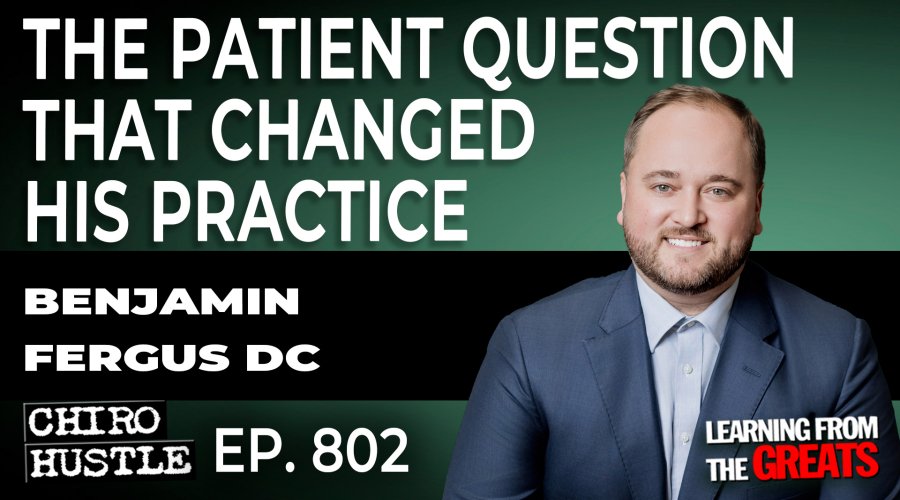
INTRODUCING Dr Benjamin Fergus DC
5 Alternate Titles
- From One Patient to a New Path with Dr Benjamin Fergus DC – Chiro Hustle Podcast 802
- Rethinking Bone-on-Bone Knees with Dr Benjamin Fergus DC – Chiro Hustle Podcast 802
- Hope Beyond Joint Replacement with Dr Benjamin Fergus DC – Chiro Hustle Podcast 802
- The Non-Surgical Joint Revolution with Dr Benjamin Fergus DC – Chiro Hustle Podcast 802
- Turning Degeneration Into Hope with Dr Benjamin Fergus DC – Chiro Hustle Podcast 802
🧠 Background
One patient asked Dr. Benjamin Fergus, DC, a question that changed the direction of his work: What could chiropractic do for a seriously degenerative joint?
At the time, the familiar path was to address the patient’s spine, offer limited support for the affected knee, and coordinate a referral when the degeneration appeared too advanced. Dr. Fergus did not want to give an automatic answer. He went to the research and began studying degenerative joint disease from the cellular level up—examining joint mechanics, tissue repair, inflammation, exercise, nutrition, recovery, and the clinical options that might help a person preserve mobility before surgery became necessary.
That search for a better answer grew into the GRIP Approach and a system Dr. Fergus now teaches to other chiropractors. After approximately 16 years of teaching 20 to 30 courses annually, he has expanded his work from adjusting instruction to an eight-hour certification course focused on non-surgical knee replacement strategies. His goal is not to claim that surgery is never appropriate. It is to help chiropractors assess each case intelligently, recognize when conservative care may still have value, and build a network of trained providers for patients seeking another option.
Dr. Fergus first encountered chiropractic as a child in Michigan. While helping in his father’s home-building business, he and his brother developed mid-back complaints. A local chiropractor offered family care, and that early experience introduced him to a profession capable of supporting physical and mental-emotional well-being without defaulting to drugs or surgery.
In this episode, Dr. Fergus and James Chester discuss hope, honest clinical judgment, the words “bone on bone,” and the responsibility to match care to the person in front of you. They also explore the chiropractic adjustment, joint decompression, progressive strengthening, recovery habits, and the value of mentoring the next generation. The result is a principled conversation about preserving motion, respecting the body’s innate capacity for healing, and knowing when collaboration or surgery truly is the right call.
🔥 Highlights
- The patient question that sent Dr. Fergus into a deep study of degenerative joint disease.
- Why a diagnosis described as “bone on bone” deserves careful imaging review and clinical context.
- How the language used in an exam room can either narrow or expand a patient’s sense of possibility.
- Why Dr. Fergus believes joint-replacement surgery can be necessary, yet may be used too early in some cases.
- The role of chiropractic adjustments, joint mobilization, traction, and decompression in a broader plan.
- Why strengthening and progressive movement must be part of supporting a degenerative joint.
- How sleep, nutrition, metabolic health, and inflammation influence the environment in which healing occurs.
- Why every recommendation must reflect the patient’s age, goals, tissue damage, function, and risk.
- How Dr. Fergus is training chiropractors to become local resources for patients seeking conservative options.
- His advice to students: value every subject, find strong mentors, and become exceptionally good at one thing.
From Our Sponsors and Partners
JAMES CHESTER (HOST): You made it to Chiro Hustle! Sit back and learn from the greatest influencers in the profession on the world’s number-one chiropractic podcast. Before we dive into this powerful episode, please remember to subscribe to our channels and give us a 5-star rating on iTunes to continue hustling.
This episode is brought to you by…
ChiroHD – More than an EHR; Practice Management, Simplified
The Chiro Speaking Company – Attract, Educate & Convert
ChiroSpring – cloud-based, user-friendly software with all the essential features chiropractors need
The Chiro Hustle Podcast is sponsored by Chiro Health USA, ChiroScript AI, Chiro Moguls, Pure Chiro Notes, Titronics, Sherman College of Chiropractic, Life Chiropractic College West, and the IFCO.
Do you want to support The Sacred Trust and uphold a Subluxation model without the grind of launching a new project? Visit our Patreon, choose the tier best suited for you. That way we can continue keeping “The Big Idea” strong, supporting speech, medical, and family health freedoms.
Now let’s hustle!
📖 Summary
A single patient question challenged Dr. Benjamin Fergus, DC, to look beyond the usual response to degenerative joint disease. Instead of assuming an arthritic knee would inevitably progress toward replacement, he investigated the research, studied the biology of degeneration and repair, and assembled a comprehensive conservative-care framework. That work ultimately became the GRIP Approach and a certification program designed to help chiropractors serve patients who want to explore non-surgical options.
In this conversation with James Chester, Dr. Fergus explains why “bone on bone” is not always a sufficiently precise description and why careful evaluation matters. He does not reject surgery; he argues for case-by-case judgment. When pain or rigidity prevents the movement necessary for health—or when damage and functional demands make repair unrealistic—joint replacement or surgical care may be appropriate. But many patients may still benefit from a thoughtful combination of chiropractic care, joint decompression, strengthening, recovery, nutrition, and other evidence-informed interventions.
The episode returns repeatedly to hope: not false promises, but the confidence that comes from understanding the person, the imaging, the research, and the options. It is also a call to chiropractors and students to keep learning, seek mentorship, sharpen their adjusting skills, and protect chiropractic’s distinct role in helping people express greater function through an optimally working nervous system and body.
🔍 Diving In
The most powerful moment in this episode happened before there was a program, a certification course, or a national teaching platform. A patient simply asked Dr. Benjamin Fergus what he could do for a degenerative joint.
It would have been easy to stay inside the familiar boundaries of care: address the back, support the knee where possible, and accept that a severely arthritic joint would eventually be referred for replacement. Instead, Dr. Fergus treated the question as a responsibility. If he did not yet know the fullest answer, he would go looking for it.
He began with the research. He explored degenerative joint disease, cellular pathways, tissue breakdown and repair, biomechanics, and the conservative interventions that might affect pain, function, and the local healing environment. What emerged was not a miracle procedure or a one-size-fits-all protocol. It was a systems view of the patient.
That distinction matters. Degeneration is not occurring in isolation. A knee lives within a person whose movement, strength, sleep, nutrition, metabolic health, inflammatory load, history, goals, and beliefs all influence what happens next. Dr. Fergus therefore describes a broad clinical framework that may include adjustments or mobilization of the joint capsule, manual traction and decompression, progressive strengthening, and—when appropriate—technologies intended to support local tissue response. He also discusses nutrition, intermittent fasting or other targeted dietary strategies, supplementation, and blood-flow-restriction training for selected patients who need a lower-load route to a meaningful exercise stimulus.
None of those elements stands alone. The chiropractic adjustment can improve motion and mechanics, but a patient must still build the capacity to use that motion. Exercise can strengthen a joint, but recovery and nutrition help establish the conditions in which the body adapts. Technology may be useful, but it must serve a sound clinical plan rather than replace one. The chiropractor’s task is to evaluate, educate, adjust, guide, and refer when the case calls for it.
The conversation becomes especially important when it turns to the phrase “bone on bone.” Patients often hear those words as a verdict: the joint is ruined, decline is unavoidable, and surgery is only a matter of time. Dr. Fergus argues that the phrase may be used too casually and that clinicians should examine the actual imaging and severity of degeneration rather than rely on a frightening label. He references staged radiographic assessment to explain that degeneration exists on a continuum and that true end-stage joint-space loss is different from earlier changes.
This is not an invitation to minimize pathology. It is a call for precision. A patient deserves to know what the findings actually show, what can reasonably be attempted, what uncertainty remains, and what signs would make a surgical consultation necessary. Precision protects patients from both therapeutic nihilism and exaggerated promises.
Dr. Fergus is equally clear that surgery has a legitimate place. Human beings need movement for cardiovascular health, strength, independence, mood, and longevity. If a painful or rigid joint has reached the point where someone cannot move enough to support overall health—and conservative options cannot restore that function—a replacement may be a life-changing intervention. Likewise, a complete traumatic injury in a young athlete with high functional demands is a different clinical problem from an incidental tear in an older adult. The right decision is not ideological; it is individual.
That principled balance makes the episode especially relevant to subluxation-centered chiropractors. Chiropractic begins with respect for the body’s innate intelligence and its drive toward organization, adaptation, and healing. The adjustment helps reduce interference and restore more normal motion and neurological function. But honoring innate intelligence does not mean ignoring damaged tissue, overstating certainty, or refusing collaboration. It means giving the body the best reasonable opportunity to express health while remaining honest about the limits of the case.
Dr. Fergus has taken what began with one patient and carried it into the profession. Through the GRIP Approach, adjusting workshops, and his non-surgical knee replacement certification, he is training chiropractors to become better equipped for the degenerative-joint cases already walking through their doors. The need became tangible when patients began contacting him from other regions and asking for a trained provider nearby. His answer could no longer stop with his own clinic; it had to become education.
The same theme shapes his advice to chiropractic students. Learn as though every subject will matter one day, because it probably will. Anatomy, pharmacology, diagnosis, adjusting, and communication may not reveal their full value while a student is still preparing for an exam. In practice, those pieces become part of the judgment required to understand the whole patient. Then find mentors who serve the kind of people you hope to serve, become truly excellent at one thing, and expand from a foundation of competence.
One question created a research mission. The research created a clinical framework. The framework created a teaching mission. And that teaching is creating more places where patients can receive a careful evaluation before accepting that their only remaining option is replacement. That is the hustle in this episode: refusing both resignation and hype, doing the work to find a better answer, and helping more chiropractors deliver it.
⚡ Action Steps
- Ask patients with degenerative-joint diagnoses what they were told, what imaging was performed, and what they believe the diagnosis means.
- Review imaging and objective findings before repeating labels such as “bone on bone.”
- Establish baseline pain, mobility, strength, function, activity tolerance, and patient goals.
- Screen for red flags and identify cases that require imaging, co-management, or surgical consultation.
- Build individualized care around restoring joint motion, reducing subluxation and mechanical dysfunction, and supporting neurological function.
- Include a progressive strengthening and movement plan that matches the patient’s current capacity.
- Evaluate sleep, nutrition, metabolic health, recovery, and other factors that may affect inflammation and adaptation.
- Reassess objectively and change course when the patient is not making meaningful progress.
- Develop relationships with trusted chiropractors, physical rehabilitation professionals, imaging providers, and orthopedic specialists.
- Choose one clinical skill to master, seek qualified mentorship, and continue studying the evidence behind the care you provide.
📢 Hashtags:
#ChiroHustle #Chiropractic #BenjaminFergusDC #JamesChester #Subluxation #ChiropracticAdjustment #KneePain #JointHealth #DegenerativeJointDisease #Arthritis #NonSurgicalCare #ChiropracticPhilosophy #InnateIntelligence #ClinicalSkills #PatientEducation #MovementIsLife #ChiropracticStudents #PracticeGrowth
Chiro Hustle Podcast 802, Dr Benjamin Fergus DC, Benjamin Fergus chiropractor, James Chester, Chiro Hustle, GRIP Approach, non surgical joint replacement, non surgical knee replacement, bone on bone knee, degenerative joint disease, knee arthritis, chiropractic for knee pain, chiropractic extremity adjusting, chiropractic adjustment, joint decompression, knee traction, conservative joint care, arthritis treatment options, knee replacement alternatives, blood flow restriction training, BFR training, shockwave therapy, chiropractic philosophy, subluxation centered chiropractic, innate intelligence, chiropractic clinical skills, chiropractic mentorship, chiropractic student advice, chiropractor education, patient communication, joint regeneration research, mobility and longevity