
The Night Reggie Gold Came Back with Dr Charles Gibson DC – Chiro Hustle Podcast 805
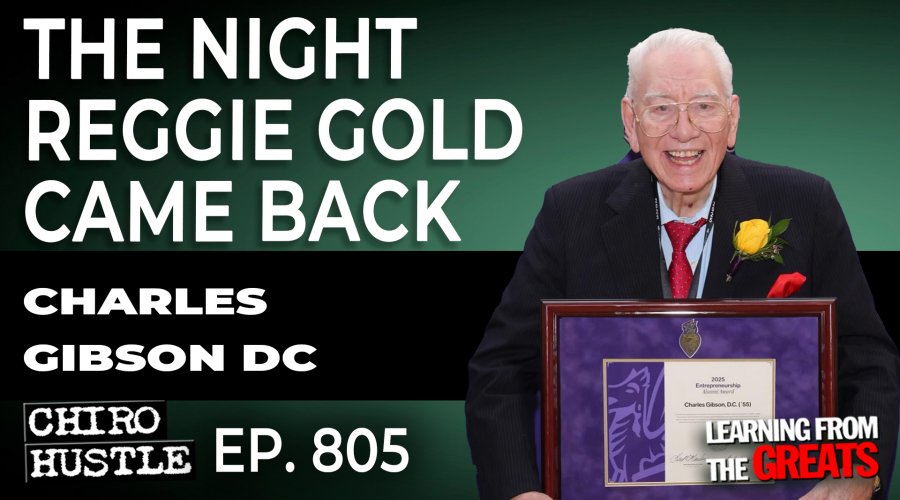
INTRODUCING Dr Charles Gibson DC
5 Alternate Titles
- Calling Reggie Gold Back Home with Dr Charles Gibson DC – Chiro Hustle Podcast 805
- Sitting at the Feet of Chiropractic Giants with Dr Charles Gibson DC – Chiro Hustle Podcast 805
- Lessons from Chiropractic’s Giants with Dr Charles Gibson DC – Chiro Hustle Podcast 805
- Protecting Chiropractic’s Legacy with Dr Charles Gibson DC – Chiro Hustle Podcast 805
- Preparing Students for Practice with Dr Charles Gibson DC – Chiro Hustle Podcast 805
🧠 Background
Few chiropractors can speak about the profession’s formative leaders from firsthand experience. Dr Charles “Chuck” Gibson DC can.
Beginning chiropractic college in 1951 and graduating in 1955, Dr Gibson entered the profession during an extraordinary period. He listened to B.J. Palmer address the student body, shared classrooms and speaking clubs with future Life College founder Dr Sid Williams, knew renowned chiropractic philosopher Reggie Gold, and studied alongside author and ICA leader Dr Fred Barge. These were not distant historical figures to him. They were teachers, classmates, colleagues, and friends.
The most powerful story in this episode centers on Reggie Gold. After becoming discouraged by chiropractic’s movement away from its philosophical foundation, Reggie left the profession and developed Spinology. Before a Gibson Plus program in Quebec City, Dr Gibson sat down with Reggie and told him that he could influence chiropractic far more effectively from inside the profession than from outside it. Reggie listened, returned to the chiropractic stage, delivered a two-hour presentation, and received a standing ovation.
That moment captures the central message of this conversation: when principled chiropractors remain engaged, speak clearly, and call one another back to chiropractic’s purpose, they can change the profession’s direction.
Dr Gibson also addresses three concerns about chiropractic education: the erosion of chiropractic philosophy, the immense debt carried by many graduates, and the lack of meaningful preparation for private practice. In his view, students must understand subluxation, chiropractic philosophy, and the responsibility of serving through the adjustment—but they must also know how to build and operate a sustainable practice.
This episode preserves stories that could otherwise be lost while issuing a direct challenge to today’s profession: honor the giants, protect the principle, and prepare the next generation to succeed.
🔥 Highlights
- Dr Gibson recalls entering chiropractic college in 1951 and graduating in the influential class of 1955.
- He describes B.J. Palmer’s commanding presence, discipline, writing habits, innovation, and extraordinary ability as an orator.
- He shares how his work as a hotel bell captain created unexpected opportunities to learn from chiropractic leaders.
- Dr Gibson recounts Reggie Gold’s remarkable journey from wartime service to chiropractic philosophy.
- He reveals the conversation that helped persuade Reggie to return to the chiropractic profession.
- He remembers Dr Sid Williams as a determined leader whose vision ultimately created Life College.
- Dr Gibson reflects on the painful final chapter of Sid’s leadership and the endurance of his legacy.
- He honors Dr Fred Barge’s quieter but lasting influence through leadership, teaching, and eight books.
- He warns that chiropractic philosophy and subluxation-centered language are being diminished in some schools.
- He calls for accredited business and practice training so graduates can serve successfully without being overwhelmed by debt.
From Our Sponsors and Partners
JAMES CHESTER (HOST): You made it to Chiro Hustle! Sit back and learn from the greatest influencers in the profession on the world’s number-one chiropractic podcast. Before we dive into this powerful episode, please remember to subscribe to our channels and give us a 5-star rating on iTunes to continue hustling.
This episode is brought to you by…
ChiroHD – More than an EHR; Practice Management, Simplified
The Chiro Speaking Company – Attract, Educate & Convert
ChiroSpring – cloud-based, user-friendly software with all the essential features chiropractors need
The Chiro Hustle Podcast is sponsored by Chiro Health USA, ChiroScript AI, Chiro Moguls, Pure Chiro Notes, Titronics, Sherman College of Chiropractic, Life Chiropractic College West, and the IFCO.
Do you want to support The Sacred Trust and uphold a Subluxation model without the grind of launching a new project? Visit our Patreon, choose the tier best suited for you. That way we can continue keeping “The Big Idea” strong, supporting speech, medical, and family health freedoms.
Now let’s hustle!
📖 Summary
Dr Charles Gibson DC takes listeners inside a remarkable era of chiropractic history through firsthand stories of B.J. Palmer, Reggie Gold, Dr Sid Williams, and Dr Fred Barge.
At the heart of the episode is Dr Gibson’s pivotal conversation with Reggie Gold, who had stepped outside the profession after becoming discouraged by its philosophical direction. Dr Gibson urged him to return, arguing that he could influence chiropractic more powerfully from within. Reggie subsequently addressed a Gibson Plus audience for two hours and received a standing ovation—beginning a renewed chapter of service to the profession.
These recollections lead into an urgent discussion about chiropractic education. Dr Gibson identifies three serious challenges: the weakening of chiropractic philosophy, the crushing cost of professional education, and inadequate preparation for the realities of private practice.
His message is both historical and forward-looking. Chiropractic students need more than clinical information. They need a firm understanding of the vertebral subluxation, the chiropractic principle, communication, leadership, and ethical business operation. Without these foundations, graduates may possess a degree yet remain unprepared to build a practice capable of serving their communities.
Episode 805 is a call to preserve chiropractic’s history, strengthen its philosophical foundation, and equip the next generation to carry the Sacred Trust forward.
🔍 Diving In
The emotional and philosophical center of this episode is a simple conversation between two chiropractors.
Reggie Gold had become deeply concerned that the profession was abandoning chiropractic philosophy. Concluding that he could no longer accomplish his purpose within chiropractic, he stepped away and developed Spinalogy. Dr Gibson believed Reggie’s departure deprived the profession of one of its most powerful teachers.
Before a Gibson Plus event in Quebec City, Dr Gibson sat with Reggie and challenged his decision. His message was straightforward: Reggie could influence chiropractic far more from within the profession than from outside it.
That appeal mattered because it was not merely about organizational loyalty. It was a call to remain engaged in the difficult work of protecting the principle. Reggie accepted the invitation, spoke for two hours, and received a standing ovation. In Dr Gibson’s telling, that event helped bring an essential philosophical voice back into chiropractic.
The story offers a lesson for every generation. Disillusionment can make withdrawal feel principled, but leaving may surrender the very ground that needs defending. Chiropractic advances when people of conviction remain present—teaching students, mentoring doctors, speaking truthfully, and demonstrating the principle in practice.
Dr Gibson’s recollections of B.J. Palmer reinforce the importance of conviction. B.J. arrived prepared, began on time, spoke without notes for extended periods, wrote prolifically, defended chiropractic, and used emerging media to extend its reach. His influence came not only from what he believed but also from the discipline and courage with which he communicated it.
The stories of Sid Williams and Fred Barge reveal different forms of leadership. Sid brought intensity, determination, and an uncompromising sense of mission. He built a high-volume practice, expanded into multiple clinics, and founded the institution that became Life University. Fred Barge exerted a quieter influence through writing, teaching, governance, and service to the ICA. One built institutions; the other built an enduring body of thought. Both helped keep chiropractic philosophy alive.
Dr Gibson then brings the historical discussion into the present. His first concern is the diminishing role of chiropractic philosophy in education. Technique and clinical proficiency matter, but they do not independently explain the profession’s distinct purpose. Students should understand the chiropractic premise: the body is self-developing, self-maintaining, and self-healing; the nervous system is central to the coordination of life; vertebral subluxation can interfere with that expression; and the chiropractor’s specific service is to locate, analyze, and correct subluxation through the adjustment.
Without that foundation, chiropractic risks being reduced to a collection of procedures for temporary symptom management. A subluxation-centered education gives students a coherent reason for what they do and equips them to communicate chiropractic without exaggeration, fear, or borrowed medical identity.
Dr Gibson’s second concern is educational cost. He contrasts the modest tuition of his student years with the enormous debt facing many contemporary graduates. Although the economics and requirements of professional education have changed substantially, the practical problem remains: heavy debt can restrict a young chiropractor’s choices before practice even begins. It can produce fear, dependence, and pressure to make decisions based on immediate financial survival rather than long-term service.
His third concern is the failure to prepare students for private practice. A chiropractor may be excellent at analyzing and adjusting the spine yet struggle if never taught budgeting, team leadership, communication, scheduling, compliance, collections, ethical marketing, or patient education. Practice competence is not separate from service. A sustainable practice is the vehicle through which a chiropractor can consistently deliver care.
Business education should never turn chiropractic into a purely commercial transaction. It should help doctors create stable, principled practices that allow them to serve without compromising their values. Students need to learn how to explain chiropractic honestly, invite people into care appropriately, manage resources responsibly, and lead with confidence.
Dr Gibson identifies the creation of a credit-bearing practice training program as a legacy he would be proud to leave. That vision deserves serious consideration. Such a curriculum could integrate philosophy, communication, leadership, financial literacy, and practical operations throughout a student’s education instead of adding a brief business seminar immediately before graduation.
The deepest lesson of this episode is that preserving chiropractic requires more than admiring its giants. Their example must become present action.
B.J. Palmer used his voice. Reggie Gold returned when called. Sid Williams built institutions. Fred Barge wrote and taught. Dr Gibson preserved their stories and challenged chiropractic education to improve.
The responsibility now belongs to the profession: tell the stories, teach the principle, correct subluxations with skill, mentor students, build ethical practices, and ensure that the next generation is prepared to carry the Sacred Trust.
⚡ Action Steps
- Study the foundational writings of B.J. Palmer and other major chiropractic philosophers.
- Develop a clear, truthful explanation of vertebral subluxation and the chiropractic adjustment.
- Share this episode with a chiropractic student or recent graduate.
- Invite an experienced, principled chiropractor to become a long-term mentor.
- Learn the financial fundamentals of opening and sustaining a chiropractic practice.
- Build a realistic plan for managing educational debt before graduation.
- Practice public speaking so the chiropractic message can be communicated with confidence.
- Encourage chiropractic schools to strengthen philosophy and credit-bearing practice education.
- Record the stories of senior chiropractors before their firsthand history is lost.
- Choose one concrete way to protect and advance chiropractic from within the profession.
📢 Hashtags:
#ChiroHustle #ChiroHustlePodcast #Chiropractic #Chiropractor #ChiropracticPhilosophy #Subluxation #VertebralSubluxation #BJPalmer #ReggieGold #SidWilliams #FredBarge #ChiropracticEducation #ChiropracticStudents #SacredTrust #InnateIntelligence #PracticeSuccess #ChiropracticLeadership
Chiro Hustle, Chiro Hustle Podcast, Chiro Hustle Podcast 805, Dr Charles Gibson DC, Charles Gibson chiropractor, Chuck Gibson chiropractor, chiropractic podcast, chiropractic history, chiropractic philosophy, subluxation centered chiropractic, vertebral subluxation, chiropractic adjustment, B.J. Palmer, BJ Palmer chiropractic, Reggie Gold, Reggie Gold chiropractic, Sid Williams chiropractor, Life College history, Life University history, Fred Barge chiropractor, Sacred Trust chiropractic, innate intelligence, universal intelligence, chiropractic education, chiropractic school debt, student loan debt chiropractors, chiropractic students, chiropractic business training, how to start a chiropractic practice, chiropractic practice success, chiropractic leadership, principled chiropractic, future of chiropractic