
Protecting Myself & the Sacred Trust with Software – Dr Dwayne Hoskins DC – Chiro Hustle Podcast 819
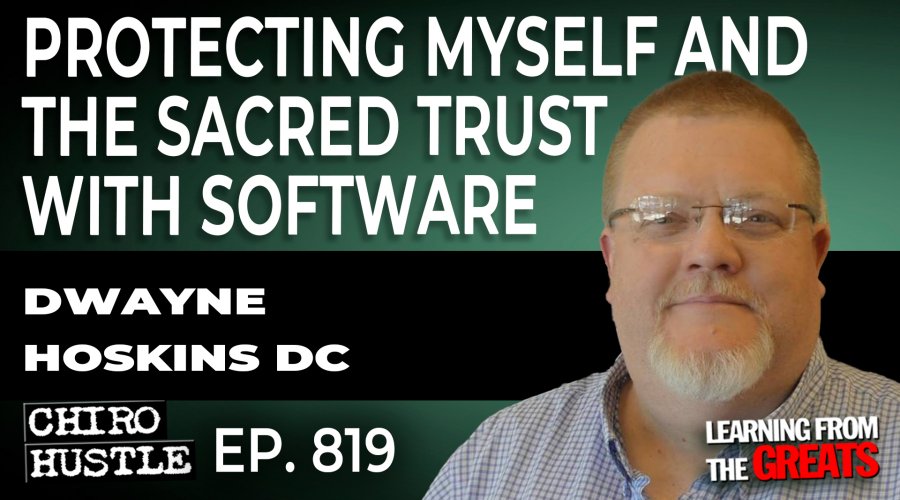
INTRODUCING Dr Dwayne Hoskins DC ACP
5 Alternate Titles
- Protect the Sacred Trust with Dr Dwayne Hoskins DC ACP – Chiro Hustle Podcast 819
- Why Your Notes Should Be Chiropractic with Dr Dwayne Hoskins DC ACP – Chiro Hustle Podcast 819
- 85 Visits and Notes Done with Dr Dwayne Hoskins DC ACP – Chiro Hustle Podcast 819
- Stop Practicing Medicine in Chiropractic with Dr Dwayne Hoskins DC ACP – Chiro Hustle Podcast 819
- Philosophically Congruent Notes with Dr Dwayne Hoskins DC ACP – Chiro Hustle Podcast 819
- When Philosophy Saved My Practice with Dr Dwayne Hoskins DC ACP – Chiro Hustle Podcast 819
🧠 Background
What happens when the way you practice no longer matches what you believe chiropractic actually is?
For Dr Dwayne Hoskins DC ACP, that question became intensely personal.
After years in practice, Dwayne found himself practicing chiropractic inside a medical and insurance-driven model that increasingly conflicted with his understanding of chiropractic philosophy. The conflict became so severe that he eventually stepped away from practice and reevaluated why he had become a chiropractor in the first place.
That period became a turning point.
Rather than abandoning chiropractic, Dwayne went deeper into it. He studied the history and philosophy of the profession, surrounded himself with mentors such as Dr Tim Langley, reconsidered the business model of practice, and began rebuilding his professional life around a simple question: If chiropractic has its own philosophy, analysis, art, and purpose, why are chiropractors documenting and operating as though they are practicing medicine?
That question ultimately contributed to the development of pureCHIROnotes, an Electronic Chiropractic Record designed around the chiropractic encounter rather than forcing chiropractors into a medically structured EHR.
Instead of beginning with a database and forcing the doctor to feed it information, pureCHIROnotes was reverse-engineered around what actually happens in a chiropractic office: What did you find? What did you do? What happens next?
The result is more than software. It represents Dwayne’s larger argument throughout Episode 819: philosophy is not decoration around chiropractic. It is the foundation that determines how chiropractors analyze, adjust, document, practice, conduct business, teach, associate, and serve.
Dwayne and James Chester also explore the Sacred Trust, mentorship, professional associations, chiropractic education, service to the profession, the future of chiropractic, and the responsibility of established chiropractors to pass what they have learned to the next generation.
At the center of the conversation is one challenge:
If we say we practice chiropractic, does everything we do actually reflect chiropractic?
🔥 Highlights
- Dwayne explains why philosophy is the foundation beneath the science and art of chiropractic.
- A deeper examination of B.J. Palmer’s Sacred Trust and what it means to guard, protect, use, and pass it forward.
- Dwayne shares the personal crisis that forced him to reconsider how he was practicing chiropractic.
- How Dr Tim Langley became a mentor and challenged Dwayne to study chiropractic history and philosophy more deeply.
- Why Dwayne believes chiropractic practice systems should be built from chiropractic philosophy rather than borrowed medical assumptions.
- The origin of pureCHIROnotes and why Dwayne calls it an Electronic Chiropractic Record rather than an Electronic Health Record.
- The two mandates behind pureCHIROnotes: keep it as simple as possible and accurately document what happened on the table.
- The remarkable Union example: approximately 85 visits in four hours with the notes completed before Dwayne left the office.
- Why experienced chiropractors have a responsibility to remain connected with students, younger doctors, associations, and the profession.
- Dwayne explains why he sees more hope for the future of chiropractic today than he did ten years ago.
From Our Sponsors and Partners
JAMES CHESTER (HOST): You made it to Chiro Hustle! Sit back and learn from the greatest influencers in the profession on the world’s number-one chiropractic podcast. Before we dive into this powerful episode, please remember to subscribe to our channels and give us a 5-star rating on iTunes to continue hustling.
This episode is brought to you by…
ChiroHD – More than an EHR; Practice Management, Simplified
The Chiro Speaking Company – Attract, Educate & Convert
ChiroSpring – cloud-based, user-friendly software with all the essential features chiropractors need
Kordara Health – Kodara Health works with doctors & chiropractors to help them build an “AI Version” of themselves so they can stop seeing patients 1-on-1 in person, and be able to scale their clinic fully online.The Chiro Hustle Podcast is sponsored by Chiro Health USA, ChiroScript AI, Chiro Moguls, Pure Chiro Notes, Titronics, Sherman College of Chiropractic, Life Chiropractic College West, and the IFCO.
Do you want to support The Sacred Trust and uphold a Subluxation model without the grind of launching a new project? Visit our Patreon, choose the tier best suited for you. That way we can continue keeping “The Big Idea” strong, supporting speech, medical, and family health freedoms.
Now let’s hustle!
📖 Summary
In Episode 819 of the Chiro Hustle Podcast, James Chester turns the microphone toward longtime Chiro Hustle team member Dr Dwayne Hoskins DC ACP for a conversation about philosophy, service, technology, and protecting the identity of chiropractic.
Dwayne recounts reaching a profound personal and professional breaking point while practicing within a medical and insurance-driven model that conflicted with what he believed chiropractic was. Rather than leaving the profession, he stepped away, studied its history and philosophy more deeply, found mentors, and rebuilt his practice around chiropractic principles.
That journey eventually helped produce pureCHIROnotes, an Electronic Chiropractic Record designed around the actual chiropractic encounter. Its guiding idea is simple: let the chiropractor focus on analyzing and adjusting while technology handles unnecessary administrative complexity in the background.
Dwayne demonstrates the concept with a striking example from his Union, South Carolina practice: roughly 85 visits in four hours, with his documentation finished before leaving the office.
The conversation expands beyond software into the Sacred Trust, mentorship, professional associations, chiropractic education, principled business decisions, service, and the responsibility to preserve chiropractic for the next generation.
Ultimately, Episode 819 asks chiropractors to examine whether their tools, systems, records, organizations, and daily decisions actually reflect the philosophy they claim to practice.
🔍 Diving In
There is a sentence underneath almost everything Dr Dwayne Hoskins says in Episode 819:
Your philosophy eventually shows up in your actions.
That makes philosophy far more than an academic discussion.
If philosophy determines what chiropractic is, then it eventually determines what the doctor looks for, what the doctor calls what they find, what the doctor does about it, how the encounter is documented, how the patient relationship is structured, which organizations the doctor supports, which businesses receive the doctor’s money, and what gets passed to the next generation.
Dwayne begins by challenging a common dismissal: “You’re just the philosophy guy.”
His response is essentially that philosophy is the foundation. Calling someone “the philosophy guy” is like criticizing the person who built the foundation of the skyscraper. If the foundation is compromised, everything built above it eventually becomes unstable.
That leads directly into his understanding of the Sacred Trust.
Dwayne does not interpret guarding the Sacred Trust as placing historic chiropractic ideas safely in storage. Something guarded can still be displayed, taught, used, defended, and handed forward. The responsibility is not merely to preserve artifacts from chiropractic’s past. It is to keep the foundational identity of chiropractic alive enough to guide its future.
That becomes intensely personal when Dwayne describes an earlier period of practice.
He loved chiropractic, but the way he was practicing had increasingly become wrapped in medicine, physical medicine, insurance systems, and assumptions he no longer believed were consistent with the reason he became a chiropractor. The internal contradiction became severe enough that he stepped away from practice.
The sabbatical gave him the opportunity to ask a more fundamental question:
Why do I do what I do?
He returned to the idea that the body possesses an extraordinary capacity to manage, maintain, adapt, and heal. He began intentionally seeking people who didn’t simply talk about chiropractic philosophy but lived consistently with it.
One of those people was Dr Tim Langley.
Langley challenged Dwayne not merely to adopt a different practice model but to study the history, understand the philosophy, know the people who had protected it, and support existing principled movements rather than constantly creating another chiropractic organization.
Dwayne also began teaching.
Teaching forced him to learn differently. His method became taking complicated material, reducing it to its essential elements, and then rebuilding the concept with the student until the complexity could be understood from the foundation upward.
That same approach eventually showed up in technology.
When Dwayne wanted software for his own practice, he discovered systems built around the assumptions of electronic health records and medical SOAP documentation. His question was simple: why should software designed for a chiropractic encounter begin with somebody else’s model of healthcare?
So he reversed the process.
Instead of engineers building a database and telling chiropractors how to feed information into it, Dwayne began with what actually happens inside the chiropractic office and required the technology to conform to that experience.
What did you find?
What did you do?
What’s next?
That became the conceptual foundation of pureCHIROnotes.
Dwayne calls it an Electronic Chiropractic Record — ECR — rather than merely an EHR because the distinction describes the purpose of the tool.
And despite additional integrations, communications, scheduling, payment processing, client portals, and automation, Dwayne repeatedly returns to two mandates:
Keep it as simple as possible.
Document what happened on the table.
Everything else should happen in the background wherever possible.
That philosophy produces one of the most compelling moments of the episode.
At the Union, South Carolina office, Dwayne describes seeing approximately 85 people in four hours. For many chiropractors, the documentation associated with that volume could mean hours of charting after patients have gone home.
His notes were completed before he left.
That is more than a software demonstration.
It exposes the real cost of poorly designed systems: hours taken away from family, life, service, thinking, teaching, and the actual work of being a chiropractor.
Technology should not become another master the chiropractor serves.
It should serve the chiropractor.
The conversation then broadens from software to stewardship.
Dwayne argues that veteran chiropractors cannot simply disappear from professional gatherings once continuing education is no longer required. Those doctors possess decades of lived experience that younger doctors and students desperately need.
Who holds the trust?
Often, it is the people who have been practicing for thirty, forty, or fifty years.
If they stop showing up, the next generation loses direct contact with the people who received chiropractic from the generation before them.
That is why associations, conferences, mentorship, and professional relationships matter beyond CE hours.
Dwayne’s challenge also extends to economics.
Where does the chiropractic dollar go?
Do chiropractors financially support companies, organizations, educational institutions, technologies, and vendors that strengthen the profession they claim to love? Or do convenience and habit cause them to fund systems that move chiropractic farther away from its foundational identity?
Every dollar becomes, in some measure, a vote for what survives.
Episode 819 therefore becomes much larger than an interview about pureCHIROnotes.
It is about congruence.
Does the doctor’s philosophy match the doctor’s practice?
Does the practice match the documentation?
Does the documentation match what occurred at the table?
Do the doctor’s business relationships support the profession?
Are experienced chiropractors transferring what they know?
And are the profession’s tools helping chiropractors become more chiropractic—or gradually requiring chiropractic to become something else?
Dwayne ends from a place of hope.
He sees institutions changing. He sees younger chiropractors searching. He sees new organizations forming, principled institutions growing, and opportunities for chiropractic to become increasingly confident in its own identity.
But that future is not automatic.
It requires chiropractors willing to understand the Sacred Trust, guard it well, use it, teach it, support it, and hand it forward.
⚡ Action Steps
- Define chiropractic for yourself. Be able to clearly explain what chiropractic is and why you practice it.
- Audit your congruence. Examine whether your analysis, adjusting, documentation, communication, and business systems reflect that definition.
- Study the Sacred Trust. Understand what was entrusted to the profession rather than relying on secondhand descriptions.
- Find mentors who live their philosophy. Look for people whose practice and behavior match what they teach.
- Teach what you learn. Teaching forces deeper understanding and helps preserve knowledge for the next generation.
- Measure the administrative burden of your office. Track how much time is spent charting and performing tasks that technology could perform automatically.
- Make technology serve the adjustment. Choose tools that support the chiropractic encounter instead of forcing the encounter to fit the software.
- Participate in principled professional associations. Do not leave younger chiropractors to discover the profession without access to experienced doctors.
- Audit where your money goes. Know whether the organizations and businesses you support strengthen or undermine the kind of chiropractic you want to preserve.
- Pass the trust forward. Protect chiropractic not by hiding its history, but by practicing, teaching, demonstrating, and improving upon it for the next generation.
📢 Hashtags:
#ChiroHustle #Chiropractic #pureCHIROnotes #DwayneHoskins #ChiropracticPhilosophy #Subluxation #SubluxationCentered #SacredTrust #ChiropracticTechnology #ChiropracticSoftware #ChiropracticLeadership #ChiropracticBusiness #ChiropracticPractice #ChiropracticStudents #ChiropracticEducation #PrincipledChiropractic #ChiropracticAdjustment #ChiropracticHistory #FutureOfChiropractic #JamesChester
Chiro Hustle Podcast, Chiro Hustle Podcast 819, Dr Dwayne Hoskins, Dwayne Hoskins DC, Dwayne Hoskins DC ACP, James Chester, pureCHIROnotes, pure Chiro notes, chiropractic notes, chiropractic documentation, chiropractic software, chiropractic EHR, electronic chiropractic record, ECR chiropractic, chiropractic practice software, chiropractic technology, chiropractic philosophy, principled chiropractic, subluxation centered chiropractic, subluxation based chiropractic, vertebral subluxation, chiropractic adjustment, Sacred Trust chiropractic, BJ Palmer Sacred Trust, BJ Palmer chiropractic, chiropractic history, chiropractic business, chiropractic membership practice, chiropractic practice management, chiropractor burnout, chiropractic chart notes, faster chiropractic notes, chiropractic automation, chiropractic AI, chiropractic leadership, Palmetto State Chiropractic Association, PSCA chiropractic, IFCO chiropractic, chiropractic associations, chiropractic mentorship, chiropractic students, chiropractic education, Sherman College chiropractic, future of chiropractic, chiropractic profession, chiropractic practice growth, principled chiropractor, chiropractic entrepreneur, chiropractic podcast