
Chiropractic Without the Performance with Dr Rachel Taylor DC – Chiro Hustle Podcast 820
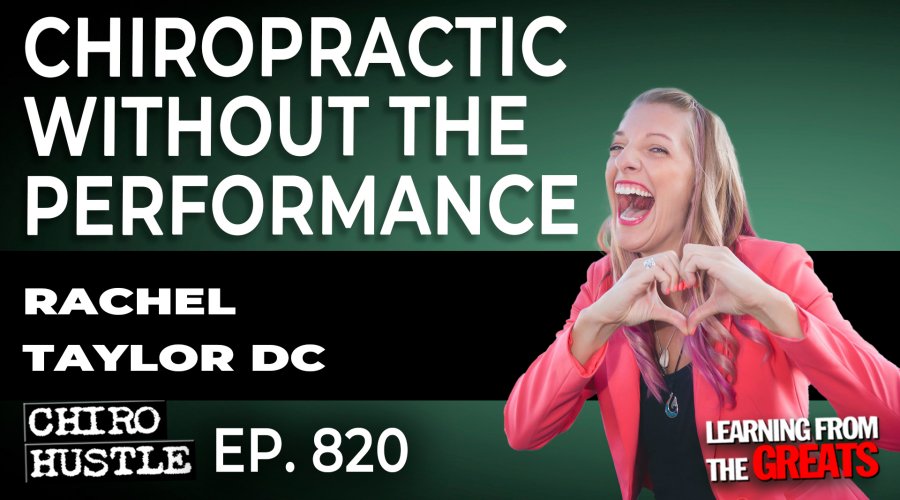
INTRODUCING Dr Rachel Taylor DC
5 Alternate Titles
- Be Yourself and Serve the One with Dr Rachel Taylor DC – Chiro Hustle Podcast 820
- Coming Home to Chiropractic with Dr Rachel Taylor DC – Chiro Hustle Podcast 820
- The Art of Presence with Dr Rachel Taylor DC – Chiro Hustle Podcast 820
- Music Mastery Love and Service – Dr Rachel Taylor DC – Chiro Hustle Podcast 820
- You Don’t Have to Perform with Dr Rachel Taylor DC – Chiro Hustle Podcast 820
🧠 Background
Dr. Rachel Taylor DC did not grow up dreaming of becoming a chiropractor. She grew up thinking of herself as a musician.
Science and music lived in different compartments in her mind. Performance, singing, and artistic expression belonged on one side. Chiropractic belonged somewhere else—interesting and familiar because her uncle was a chiropractor, but not necessarily something she imagined herself doing.
That began to change when Rachel asked herself a deceptively simple question: Is chiropractic a skill I want to possess at the end of my life?
Her answer was yes.
That decision eventually led her to Life University and into a profession where she discovered that the boundaries she had created between science, art, philosophy, spirituality, and music were not nearly as solid as she had imagined.
Today, Rachel practices in San Antonio at Chiro Casa, which she describes as a “home for healing.” Her approach emphasizes presence, safety, listening, specificity, and honoring the person receiving the adjustment.
Her involvement with MLS—Mastery, Love and Service—deepened that approach. Carrying forward the influence of Dr. Arno Burnier and other mentors, Rachel believes chiropractic should never become a performance built around creating a dramatic sound or imposing the chiropractor’s intention upon the person on the table. The adjustment should be specific, respectful, and delivered from a place of presence.
But the deeper message of this conversation reaches beyond technique.
Rachel speaks directly to chiropractors and students who feel pressure to become someone else—to imitate the speaker on stage, build the biggest practice, follow somebody else’s system, or measure themselves against the most visible people in the profession.
Her answer is simple:
Be yourself.
Stay curious.
Be present.
Serve the one person in front of you.
Because chiropractic does not need another imitation of somebody else.
It needs you.
🔥 Highlights
- Rachel’s journey from musician to chiropractor.
- The question that changed her direction: Is chiropractic a skill she wanted for life?
- Why chiropractic and music turned out to have far more in common than she expected.
- Curiosity as an alternative to the mechanistic-versus-vitalistic battle.
- Why an adjustment should never simply be about producing a “pop.”
- The philosophy behind MLS—Mastery, Love and Service.
- Honoring the person, the nervous system, and what is needed in that moment.
- Why chiropractors should stop measuring themselves against people on stages.
- The creation of Chiro Casa as a place where people can feel safe and “come home” to themselves.
- Rachel’s central message to chiropractors and students: be present, stay open, and be yourself.
From Our Sponsors and Partners
JAMES CHESTER (HOST): You made it to Chiro Hustle! Sit back and learn from the greatest influencers in the profession on the world’s number-one chiropractic podcast. Before we dive into this powerful episode, please remember to subscribe to our channels and give us a 5-star rating on iTunes to continue hustling.
This episode is brought to you by…
ChiroHD – More than an EHR; Practice Management, Simplified
The Chiro Speaking Company – Attract, Educate & Convert
ChiroSpring – cloud-based, user-friendly software with all the essential features chiropractors need
Kordara Health – Kodara Health works with doctors & chiropractors to help them build an “AI Version” of themselves so they can stop seeing patients 1-on-1 in person, and be able to scale their clinic fully online.The Chiro Hustle Podcast is sponsored by Chiro Health USA, ChiroScript AI, Chiro Moguls, Pure Chiro Notes, Titronics, Sherman College of Chiropractic, Life Chiropractic College West, and the IFCO.
Do you want to support The Sacred Trust and uphold a Subluxation model without the grind of launching a new project? Visit our Patreon, choose the tier best suited for you. That way we can continue keeping “The Big Idea” strong, supporting speech, medical, and family health freedoms.
Now let’s hustle!
📖 Summary
Dr. Rachel Taylor DC joins Chiro Hustle Podcast 820 for a conversation about chiropractic, identity, presence, music, and the pressure to perform.
Rachel once believed music and chiropractic occupied two completely different worlds. Over time, she discovered that chiropractic is itself an art—one requiring listening, timing, rhythm, adaptability, and presence.
Through her work with MLS—Mastery, Love and Service—Rachel has learned to approach the adjustment as something far more significant than creating movement or making a sound. The chiropractor must listen to the person, honor the nervous system, remain present, and deliver what is appropriate in that moment.
That philosophy also shaped Chiro Casa, her San Antonio practice designed to feel less like a performance-driven environment and more like a home.
The larger message is especially important for chiropractic students and doctors tempted to compare themselves with highly visible leaders in the profession.
You do not have to become the chiropractor on the stage.
You do not have to build someone else’s practice.
You do not have to perform.
Stay curious. Develop your art. Honor chiropractic. And take care of the one person standing in front of you.
🔍 Diving In
One of the most revealing moments in this conversation happens when Dr. Rachel Taylor DC describes the mental division she once created between two parts of herself.
There was music.
And there was science.
Rachel understood herself as a performer and singer. Chiropractic was familiar because her uncle practiced it, and she had experienced chiropractic care throughout her childhood. But becoming a chiropractor seemed to belong to somebody with a different kind of brain and a different identity.
Then she asked herself a question that cut through all of those assumptions:
Would she rather reach the end of her life knowing how to do this—or not knowing?
She wanted the skill.
That choice eventually exposed something much bigger. Music and chiropractic were never as separate as she had assumed.
Both require listening.
Both require timing.
Both require sensitivity.
Both demand an awareness of what is happening now rather than mechanically repeating what happened before.
And both involve an artist responding to something alive.
Rachel even uses music as an analogy with people in her practice. One day the nervous system may need the equivalent of rock music. Another may call for classical music. Somewhere in between, something quieter may be appropriate.
The point is not the musical genre.
The point is responsiveness.
That principle carries directly into Rachel’s involvement with MLS—Mastery, Love and Service.
MLS asks chiropractors to look beyond the mechanics of simply moving a vertebra or producing an audible sound. It considers the chiropractor’s body position, longevity, state of mind, heart, presence, listening, intention, and relationship with the person receiving the adjustment.
Can the chiropractor actually see the person?
Can the chiropractor hear what is being said—and perhaps what is not being said?
Can the doctor create a moment where the person on the table feels like the most important person in the room?
And can the chiropractor deliver an adjustment without imposing force merely because the chiropractor has decided something must happen?
This is where art, philosophy, and technical mastery intersect.
Specific chiropractic care cannot simply become “make something move.”
A sound is not the objective.
A performance is not the objective.
The chiropractor is dealing with a living person and a nervous system, seeking to identify and address vertebral subluxation with specificity while honoring the individual receiving the adjustment.
That same refusal to perform shapes Rachel’s advice to the profession.
Chiropractic culture can make comparison remarkably easy.
Doctors attend seminars and watch charismatic speakers.
Students meet successful chiropractors.
Social media displays large practices, large audiences, dramatic adjustments, and recognizable personalities.
Inspiration can quietly become imitation.
Rachel experienced some of that herself. Early in school, she became convinced she already knew the model she would follow. For a period of time, she did not even explore other seminars because she thought her path had already been decided.
Fortunately, curiosity reopened the door.
She listened.
She explored.
She allowed other people and ideas to challenge her assumptions.
And gradually, the task stopped being about becoming another chiropractor.
It became about discovering Rachel.
That theme reaches its clearest expression in Chiro Casa.
Rachel describes her practice as “your home for healing.”
She wanted to recreate the feeling of those deeply human moments chiropractors often experience outside formal clinical environments: talking, connecting, laughing, listening, receiving an adjustment, and feeling comfortable enough to simply be.
The word “Casa”—home—is intentional.
The office should feel safe.
The person’s body should feel safe.
Their mind and heart should feel safe.
And through the adjustment and clearer nervous-system function, there is an invitation to come home to the body rather than constantly fighting against it.
That provides one of the strongest lessons of Episode 820.
There is no single required personality for a chiropractor.
There is no universal practice-volume number that proves purpose.
There is no requirement to reproduce the office of a mentor.
One chiropractor may serve a thousand visits per week.
Another may build an intimate, lower-volume practice.
The essential questions run deeper.
Are you practicing chiropractic?
Are you locating and addressing vertebral subluxation?
Are you developing your art?
Are you protecting your ability to serve?
Are you present?
And are you actually serving the person in front of you?
Rachel’s message ultimately removes a tremendous burden from chiropractors:
You do not have to perform your identity.
You can develop it.
You can remain curious.
You can allow your art, philosophy, personality, experiences, talents, and chiropractic skill to mature together.
Rachel did not ultimately have to choose between being a musician and being a chiropractor.
Those seemingly separate pieces became part of the same person.
And perhaps that is the challenge for every chiropractor.
Stop trying to become the person on the stage.
Stop measuring the significance of your work by somebody else’s numbers.
Stop assuming your expression of chiropractic must look like somebody else’s.
Protect the principle.
Develop the art.
Serve the person.
And be willing to be unmistakably yourself.
⚡ Action Steps
- Ask yourself: What kind of chiropractor am I actually becoming?
- Identify one area where you are imitating someone rather than developing your own authentic expression.
- Enter every adjustment with the intention to be fully present with the person in front of you.
- Separate an audible release from the definition of a successful adjustment.
- Continue refining your analysis and adjusting skills so specificity—not spectacle—guides your art.
- Protect your own body mechanics so you can serve chiropractic for decades.
- Attend seminars with curiosity rather than looking for another personality to copy.
- Listen to what practice members say—and what their nervous systems may be communicating beyond their words.
- Build a practice environment consistent with your philosophy, personality, and purpose.
- Stop asking whether your practice is as big as somebody else’s and ask whether you are faithfully serving the people entrusted to you.
📢 Hashtags:
#ChiroHustle #Chiropractic #RachelTaylorDC #ChiropracticPhilosophy #ChiropracticAdjustment #Subluxation #VertebralSubluxation #Vitalism #ChiropracticStudent #ChiropracticStudents #Chiropractor #ChiropracticLeadership #ChiropracticArt #MasteryLoveService #MLSChiropractic #ChiroCasa #InnateIntelligence #ADIO #AboveDownInsideOut #ChiropracticLife #ChiropracticPodcast #PrincipledChiropractic
Dr Rachel Taylor DC, Rachel Taylor chiropractor, Rachel Taylor chiropractic, Chiro Hustle Podcast 820, Chiro Hustle Rachel Taylor, Chiro Hustle Podcast, chiropractic podcast, chiropractic philosophy, principled chiropractic, subluxation centered chiropractic, vertebral subluxation, subluxation, chiropractic adjustment, chiropractic adjusting, chiropractic art, chiropractic science philosophy art, vitalistic chiropractic, vitalism chiropractic, innate intelligence, ADIO chiropractic, above down inside out, chiropractic students, chiropractic student advice, chiropractic career advice, chiropractic mentors, MLS chiropractic, Mastery Love and Service, Arno Burnier, chiropractic presence, specific chiropractic adjustment, Chiro Casa, San Antonio chiropractor, chiropractic identity, chiropractic practice, chiropractic leadership, chiropractic seminars, chiropractic technique, adjusting technique, chiropractor burnout, chiropractor longevity, practice authenticity, chiropractic purpose, future of chiropractic