
If You Were the Last Chiropractor on Earth with Dr Ian Mathias DC – Chiro Hustle Podcast 817
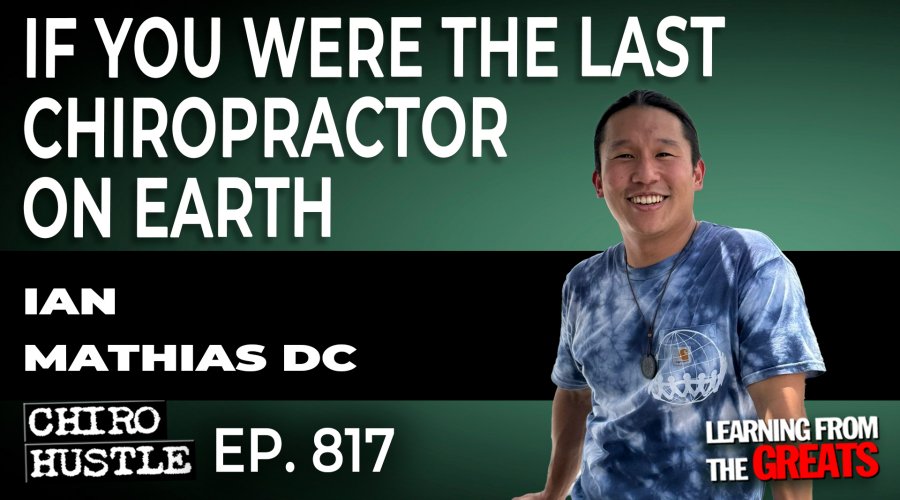
INTRODUCING Dr Ian Mathias DC
5 Alternate Titles
- Teaching Chiropractic Forward with Dr Ian Mathias DC – Chiro Hustle Podcast 817
- The Last Chiropractor with Dr Ian Mathias DC – Chiro Hustle Podcast 817
- Hold the Line for Chiropractic with Dr Ian Mathias DC – Chiro Hustle Podcast 817
- From PE Teacher to Chiropractor with Dr Ian Mathias DC – Chiro Hustle Podcast 817
- The Art of the Adjustment with Dr Ian Mathias DC – Chiro Hustle Podcast 817
🧠 Background
Dr Ian Mathias DC did not grow up planning to become a chiropractor.
He was a high school physical education teacher in Australia with a lifelong interest in sport, health, fitness, and human performance. His introduction to chiropractic came from an unlikely place: YouTube.
What began by watching chiropractic adjustment videos became something much deeper when Ian discovered chiropractors who explained the vitalistic philosophy behind what they were doing. He wanted to understand not merely the sound or mechanics of an adjustment, but the philosophy and purpose behind it.
Eventually, an injury from playing volleyball with his students brought Ian to chiropractor Dr Craig Smith. His first chiropractic experiences affected him profoundly enough that Craig began planting a seed: perhaps Ian should become a chiropractor himself.
Ian resisted the idea initially. He had already trained for one profession and had little desire to return to school.
But the seed grew.
Ian eventually retrained at Macquarie University in Sydney, while deliberately seeking much of his philosophical and adjusting education outside the university classroom. He became what he calls a “seminar junkie,” learning from mentors, attending events, studying vitalistic chiropractic, and developing certainty about what chiropractic meant to him.
His teaching background never disappeared.
During his final year as a chiropractic student, Ian started the Underground Training Group. Six students met in a park outside the university, set up portable tables, trained physically, practiced adjustments, explored technique, discussed philosophy, and investigated possibilities beyond what they were learning in the formal curriculum.
Ian kept showing up at 7:00 Friday mornings whether ten people attended, three attended, or almost nobody attended.
The group grew.
And something became clear: Ian may have left teaching as a profession, but teaching had never left Ian.
That theme reaches its defining moment in this episode when James Chester asks him a remarkable question:
If you were the last chiropractor on planet Earth, would the profession survive?
Ian answers yes.
Because he would teach.
🔥 Highlights
- How a high school PE teacher discovered chiropractic through YouTube and eventually changed careers.
- Why Ian believes chiropractic philosophy provides clarity, certainty, and purpose beyond simply having a job.
- The first chiropractic adjustment that changed Ian’s perception of what was possible.
- Why students may need to actively seek philosophy, adjusting skills, mentorship, and supplemental education outside formal university training.
- How mentors including Dr Craig Smith and Dr Jennifer Liu challenged Ian to move from knowing chiropractic philosophy to actually expressing it in practice.
- The story behind the Underground Training Group and its first six-person gathering in a park outside Ian’s university.
- Why Ian kept showing up for 7:00 a.m. Friday training sessions regardless of how many students attended.
- Why James argues that scarcity and professional isolation hurt chiropractic—and why chiropractors should deliberately build local community.
- Ian’s answer to the question: “If you were the last chiropractor on Earth, would the profession survive?”
- Ian’s call for chiropractors to raise the standard of the adjustment by becoming more present, adaptable, humble, skillful, and responsive to the individual in front of them.
From Our Sponsors and Partners
JAMES CHESTER (HOST): You made it to Chiro Hustle! Sit back and learn from the greatest influencers in the profession on the world’s number-one chiropractic podcast. Before we dive into this powerful episode, please remember to subscribe to our channels and give us a 5-star rating on iTunes to continue hustling.
This episode is brought to you by…
ChiroHD – More than an EHR; Practice Management, Simplified
The Chiro Speaking Company – Attract, Educate & Convert
ChiroSpring – cloud-based, user-friendly software with all the essential features chiropractors need
Kordara Health – Kodara Health works with doctors & chiropractors to help them build an “AI Version” of themselves so they can stop seeing patients 1-on-1 in person, and be able to scale their clinic fully online.The Chiro Hustle Podcast is sponsored by Chiro Health USA, ChiroScript AI, Chiro Moguls, Pure Chiro Notes, Titronics, Sherman College of Chiropractic, Life Chiropractic College West, and the IFCO.
Do you want to support The Sacred Trust and uphold a Subluxation model without the grind of launching a new project? Visit our Patreon, choose the tier best suited for you. That way we can continue keeping “The Big Idea” strong, supporting speech, medical, and family health freedoms.
Now let’s hustle!
📖 Summary
What happens if the future of chiropractic depends on you?
Dr Ian Mathias DC began as a high school PE teacher in Australia before discovering chiropractic online, experiencing principled chiropractic personally, and ultimately retraining to enter the profession.
But his former career never truly disappeared.
Ian became a student of the art, philosophy, and science of chiropractic—and eventually began teaching other students through the Underground Training Group, a grassroots gathering that started with six people practicing in a park outside their university.
In this episode of Chiro Hustle Podcast, Ian and James Chester explore chiropractic philosophy, mentorship, supplemental education, community, professional identity, the art of adjusting, and the responsibility each chiropractor carries for preserving the profession.
The conversation reaches its defining moment when James asks Ian whether chiropractic would survive if Ian were the last chiropractor on Earth.
Ian says yes.
He would teach it.
That answer becomes the heartbeat of Episode 817: chiropractic survives when chiropractors develop certainty, master their art, preserve the philosophy, serve the person in front of them, and teach the next generation what they know.
For Ian, chiropractic is not simply something you do.
It is something you live—and something worth passing forward.
🔍 Diving In
There is an important distinction running through this episode between learning chiropractic and becoming a chiropractor.
Dr Ian Mathias DC knows something about changing identities.
Before chiropractic, Ian was a high school physical education teacher. He enjoyed athletics, health, fitness, and helping people learn. His first exposure to chiropractic came through online videos. The adjustments caught his attention, but the chiropractors who explained the vitalistic ideas behind those adjustments captured his curiosity.
Then Ian experienced chiropractic himself.
After hurting his back playing volleyball with students, Ian visited Dr Craig Smith. The experience was different from other approaches Ian had previously encountered. Craig also consistently reinforced a central concept: the chiropractor addresses interference, while the body itself possesses the intelligence responsible for healing and adaptation.
Those conversations planted more than an appreciation for chiropractic.
They planted a possible future.
Craig told Ian that he should retrain and become a chiropractor.
Ian did not immediately accept the idea. Going back to school meant abandoning the comfort of an established profession and becoming a student again. Eventually, however, he made the decision.
Once enrolled at Macquarie University, Ian quickly recognized that his chiropractic education could not end with the required curriculum.
He pursued seminars.
He sought mentors.
He studied philosophy.
He watched other chiropractors adjust.
He trained his hands.
He attended events such as Wunda Nights and the Innate Summit.
He describes himself during those university years as a “seminar junkie.”
That pursuit eventually exposed an important weakness in his own thinking.
Ian believed he understood principled chiropractic. But during service trips to Cambodia, Dr Jennifer Liu began challenging him about whether the philosophy he professed was actually visible in the way he practiced.
That is a much harder question.
Knowing philosophy is one thing.
Allowing philosophy to determine what you do is another.
The challenge forced Ian to examine whether additional modalities and habits in practice were consistent with the identity he claimed as a chiropractor.
That process of questioning, refining, learning, and recommitting becomes one of the episode’s recurring ideas.
And it extends directly into adjusting.
Ian does not believe mastery means performing one adjustment the same way on every person.
He argues for developing a large toolbox of skills while remaining sufficiently present to determine what the person in front of you actually requires.
A particular listing does not automatically dictate one setup.
One person may respond to a supine approach. Another may need a seated adjustment. Another situation may call for an instrument.
The objective is not to demonstrate loyalty to a favorite technique.
The objective is to serve the person.
Ian describes each adjustment as a unique conversation.
That requires technical skill, but it also requires humility.
You must be willing to listen.
You must be willing to change.
You must resist allowing familiarity with one method to become rigidity.
That philosophy can be traced back to Ian’s student years.
While attending chiropractic school, Ian noticed fellow students wanting more opportunities to practice, explore technique, discuss philosophy, and learn from one another.
So he did something about it.
The Underground Training Group began with six students in a nearby park.
They brought tables.
They trained physically.
They practiced adjusting.
They shared what they had learned.
They explored ways of working with different body types and different situations.
They talked chiropractic.
And Ian showed up.
Friday.
7:00 a.m.
Again and again.
Sometimes ten students came.
Sometimes three.
Sometimes attendance was discouragingly small.
Ian showed up anyway.
That consistency created community.
Years later, some of the relationships and professional connections Ian developed through that group remain part of his chiropractic life.
It also revealed something about Ian himself.
He thought he had left teaching.
He had not.
He had simply changed what he was teaching.
That realization sets up the defining exchange of the episode.
The conversation turns toward the future of chiropractic. Ian acknowledges challenges: declining enrollment, graduates leaving the profession, philosophical disagreements, professional infighting, and uncertainty about what chiropractic might look like decades from now.
James reframes the question.
Forget the profession as an abstraction.
Imagine there is only one chiropractor left.
You.
Would chiropractic survive?
Ian’s answer is immediate:
Yes.
He would teach.
That answer contains the responsibility James wants every chiropractor to recognize.
The profession is not preserved somewhere else.
Not by an association.
Not by a school.
Not by someone with more experience.
Not by the chiropractor across town.
Each chiropractor has some responsibility for carrying chiropractic forward.
That means developing certainty.
It means continuing to learn.
It means refining the adjustment.
It means mentoring students.
It means creating community instead of operating from scarcity.
It means preserving the language and philosophy that make chiropractic distinctive.
And it means being fully present with the person on the table.
Ian’s final message brings everything together.
Set a high standard for the adjustment.
Learn more than one way of doing things.
Develop your hands.
Listen to the body.
Stay humble.
Stay adaptable.
Be present.
And recognize that becoming an excellent chiropractor is not an event completed at graduation.
It is a lifelong process.
James calls it a “forever game.”
Ian’s story demonstrates it.
The PE teacher became the chiropractic student.
The student became the chiropractor.
The chiropractor became the teacher again.
And perhaps that is exactly how chiropractic survives.
⚡ Action Steps
- Know why you adjust. Develop enough philosophical clarity that you can explain why chiropractic is distinct from other approaches.
- Seek supplemental education. Do not assume graduation completes your chiropractic education. Attend seminars, workshops, philosophy gatherings, and adjusting programs.
- Find mentors. Build relationships with chiropractors whose philosophy, skill, integrity, and practice you respect.
- Train your hands continually. Treat adjusting as an art requiring lifelong practice rather than a competency completed in school.
- Expand your toolbox. Learn multiple approaches so technique serves the person instead of forcing the person into your preferred technique.
- Practice presence. When someone is on your table, make that person the focus rather than tomorrow’s schedule, yesterday’s problems, or professional distractions.
- Create chiropractic community. Get together with other chiropractors to adjust, talk philosophy, share experiences, and eliminate unnecessary professional isolation.
- Teach somebody. Share what you know with a student, younger chiropractor, colleague, or future leader.
- Keep refining your practice identity. Give yourself permission to grow. The chiropractor you are five years from now should not be identical to the chiropractor you are today.
- Ask yourself Ian’s question: If you were the last chiropractor on Earth, would chiropractic survive in your hands?
📢 Hashtags:
#ChiroHustle #Chiropractic #Chiropractor #ChiropracticPhilosophy #Subluxation #ChiropracticAdjustment #VitalisticChiropractic #PrincipledChiropractic #ChiropracticStudents #ChiropracticEducation #ChiropracticLeadership #ChiropracticCommunity #InnateIntelligence #ChiropracticMentorship #FutureOfChiropractic
Chiro Hustle Podcast, Chiro Hustle Podcast 817, Dr Ian Mathias DC, Ian Mathias chiropractor, James Chester, chiropractic podcast, chiropractic philosophy, chiropractic adjustment, principled chiropractic, subluxation based chiropractic, subluxation centered chiropractic, vitalistic chiropractic, chiropractic students, chiropractic education, chiropractic mentorship, chiropractic leadership, chiropractic adjusting skills, art of chiropractic, chiropractic technique, chiropractic training, chiropractic community, future of chiropractic, innate intelligence, universal intelligence, chiropractic profession, chiropractic school, Australian chiropractor, chiropractic Australia, Macquarie University chiropractic, Underground Training Group, chiropractic seminars, chiropractic career, chiropractor mentorship, chiropractic purpose, chiropractic certainty, chiropractic philosophy podcast